Task Paralysis: Why You Cannot Start, and Five Moves That Unstick a Task

Task paralysis is being unable to start a task you have already decided to do, usually when that task is large, undefined, or carries a consequence you would rather not meet. Task paralysis is not a clinical diagnosis and no instrument measures it by that name. The construct underneath it is procrastination, which Piers Steel’s 2007 meta-analysis in Psychological Bulletin defines as voluntarily delaying an intended action despite expecting to be worse off for the delay. The strongest predictor in that data is not laziness. It is how unpleasant the task feels. That points at the fix: shrink the first step until it stops being unpleasant.
Which is a different instruction from the one most advice gives. The usual explanation for task paralysis is that your list is too long and the options overwhelm you, and that explanation rests on a study whose effect did not survive being meta-analysed. The sections below separate what has been measured from what gets repeated, then give the method, a worksheet to copy, and the six ways an unstick attempt usually fails.
“To procrastinate is to voluntarily delay an intended course of action despite expecting to be worse off for the delay.”
What task paralysis is, and what the research calls it
Task paralysis is the state of standing at the starting line of one specific task and not being able to move, while often being perfectly capable of doing other work that day. That last part is what distinguishes task paralysis from a general slump: the freeze is usually task-shaped, not day-shaped. People who describe task paralysis frequently report answering twelve emails and reorganising a folder in the time they did not start the one thing that mattered.
The term itself is colloquial. It grew out of ADHD and productivity communities rather than out of a journal, so searching for it in the literature returns almost nothing. The nearest measured vocabulary is worth knowing, because it is what makes the research findable: procrastination for the delay itself, task aversiveness for how unpleasant the task feels, and task initiation for the executive function that gets a decided action started.
On scale, Steel’s meta-analysis drew 691 independent correlations from 216 works and reported that procrastination chronically affects some 15 to 20 percent of adults, with 80 to 95 percent of college students engaging in it to some degree. Those figures describe procrastination broadly rather than task paralysis specifically, and no study has measured how many people experience the acute version. Any page quoting a percentage for task paralysis is quoting something nobody counted.
Why task paralysis happens
Task paralysis happens because avoidance pays immediately and the task does not. Steel’s meta-analysis puts numbers on which factors travel with procrastination, and the shape of that list is the useful part: the feelings attached to the task matter more than any character trait people usually blame.
| Factor | Correlation with procrastination | What it means in practice |
|---|---|---|
| Conscientiousness | r = -.62 | The strongest relationship in the dataset, and it is a trait rather than a lever. Knowing it does not tell you what to do on Tuesday. |
| Impulsiveness | r = .41 | Easier distraction means the aversive task loses more often. A phone in another room is a real intervention. |
| Task aversiveness | r = .40 | How unpleasant the task feels. This is the one you can change by changing the task, which is why the method below targets it. |
| Self-efficacy | r = -.38 | Believing you can do this specific thing. It rises when a task is small enough to finish, which is the mechanism behind shrinking the step. |
So the feeling is not incidental to task paralysis, it is the engine. Fuschia Sirois and Timothy Pychyl made the mechanism explicit in 2013: procrastination is best understood as short-term mood repair, where the discomfort of the task is resolved by not doing the task, and the bill lands on a future version of you.
“We prioritize our current mood over the consequences of our inaction for our future self.”
That reframing is worth sitting with, because it explains why discipline advice bounces off task paralysis. If the freeze were a motivation shortfall, more pressure would help. If the freeze is mood repair, more pressure makes the task more aversive and the relief of avoiding it larger. Pressure is fuel for the thing it is trying to fix.
Five things task paralysis gets confused with
Task paralysis is often used as a catch-all for every kind of not-working, which matters because the five neighbours below need different first moves. Telling them apart takes about a minute and saves a week of applying the wrong fix.
| Term | What it describes | How to tell it apart | What helps first |
|---|---|---|---|
| Task paralysis | Unable to start one specific decided task | You can work on other things. The freeze has a name and a shape | Shrink the first physical step until it is boring |
| Procrastination | Voluntarily delaying an intended action despite expecting to be worse off | The broader measured behaviour. Task paralysis is one acute form of it | Reduce aversiveness and remove the easier alternative |
| Overwhelm | Too much volume to hold at once, across many tasks | Nothing in particular is frozen. Everything is | A full capture, then a daily cap. See the brain dump method |
| Burnout | Exhaustion, cynicism and reduced efficacy built up over months | It does not lift after a good night of sleep or a day off | Load reduction and recovery, not a productivity method |
| Executive dysfunction | Persistent difficulty with initiation, sequencing and switching | It shows up across most tasks, in most contexts, for years | Assessment and support, with external structure around the gaps |
| Analysis paralysis | Stalling on a decision rather than on an action | The stuck part is a choice between options, not starting work | Set a decision deadline and a default to take if it passes |
If the honest answer is overwhelm rather than task paralysis, the volume problem comes first, and our piece on turning a brain dump into a to-do list is the method for that. If the honest answer is burnout or executive dysfunction, no worksheet on this page is the right tool, and a conversation with a doctor or a clinician is worth more than another system.
Five kinds of freeze, and the move each one needs
Task paralysis is not one failure, it is five, and they are distinguishable by what you notice when you try to start. The table below is the diagnostic: find the tell, take the move.
| Kind of freeze | The tell | The move |
|---|---|---|
| The task is a project | Saying the task out loud produces a sentence with no verb you could do in the next hour. “Sort out the website” | Make the task “decide the first step for the website”, and treat that decision as the whole task |
| The task is undefined | You cannot say what finished looks like, so any amount of work feels insufficient | Write one sentence describing done. If you cannot, the task is to find out from whoever can tell you |
| The task carries a consequence | You know exactly what to do and will not do it. A reply you are dreading, a number you do not want to see | Name the specific thing you are dreading in one sentence, then do the smallest version that exposes it |
| The task is blocked and you have not noticed | Every attempt stalls at the same point, usually needing information or a decision from someone else | Replace the task with the chase. The real item is a four-minute message, and the work waits for the reply |
| The body is empty | The freeze is on everything, not one task, and it lifted last time you slept properly | Stop planning. Eat, sleep, or end the day. A method applied to exhaustion just adds failure to it |
Only one of those five is about willpower, and it is the third. The other four are mislabelled tasks, which is good news: a mislabelled task can be relabelled in under a minute, and relabelling is far easier than finding motivation that is not there.
How to unstick a task in ten minutes
This is the method, in five steps, and the whole thing runs in about ten minutes. It targets task aversiveness rather than motivation, because aversiveness is the factor the research says you can move.
- Name the first physical action, in verbs. Not “work on the proposal”, but “open last quarter’s proposal and copy the pricing table into a new file”. If naming the action is hard, that difficulty is the finding: the task was a project, and defining the action is now the task.
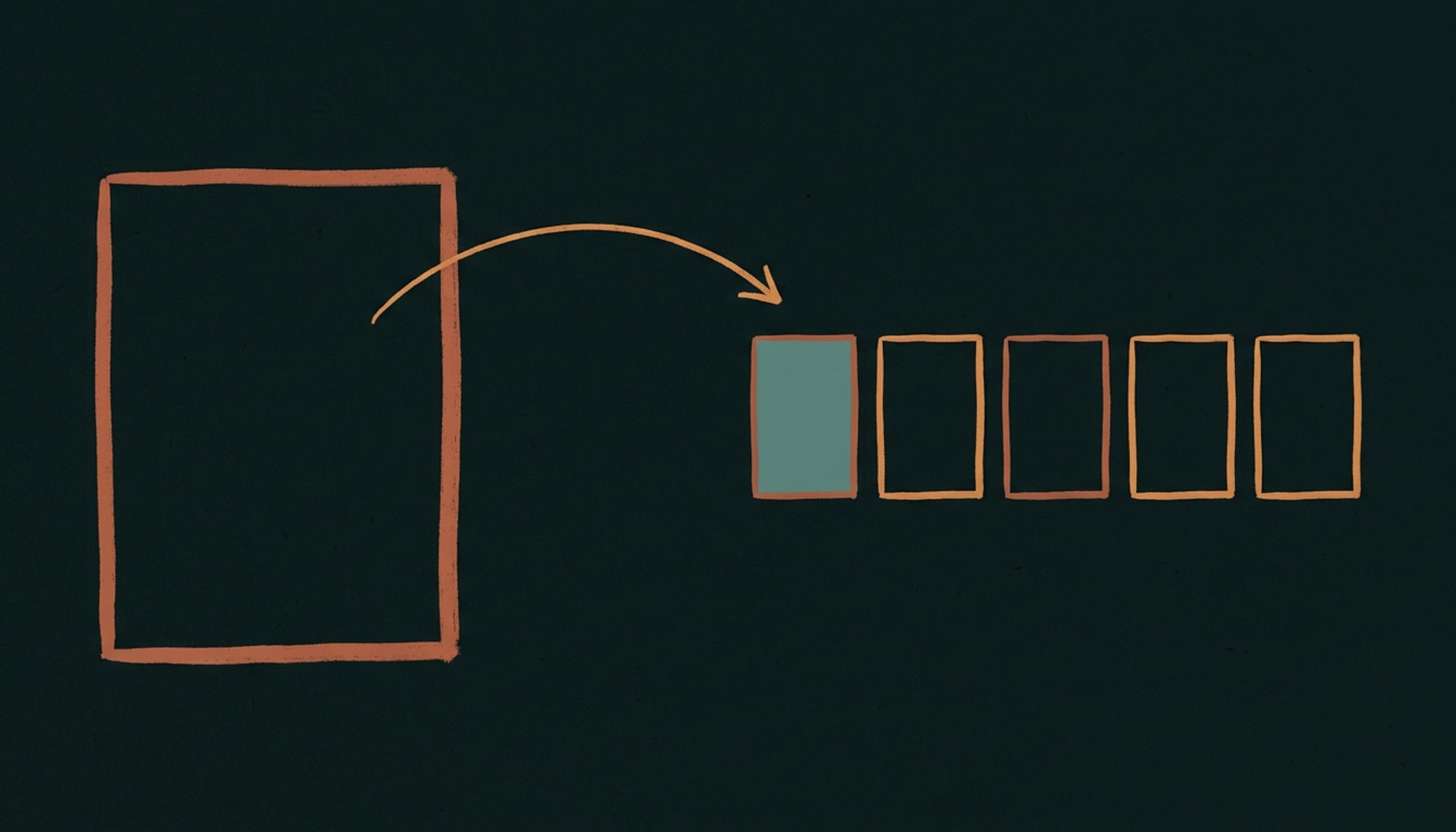
- Shrink it until it is boring. Keep halving the first action until your reaction is indifference rather than resistance. This is the step with the cleanest evidence behind it. Bandura and Schunk gave children working through 42 pages of arithmetic either a proximal subgoal of six pages a session or the distal goal of finishing all 42 by the end, and the proximal group beat every other group on performance, self-efficacy and interest.
- Attach a when and a where. Gollwitzer and Sheeran’s meta-analysis across 94 independent tests found that specifying in advance when, where and how you will act had a medium-to-large effect on whether the goal was reached, d = .65. “Tomorrow at 9:30, at the kitchen table” is doing measurable work that “tomorrow, properly” is not.
- Say what you are dreading, in one sentence. Out loud or written down. “I am dreading finding out the invoice is nine weeks overdue and that it is my fault for not chasing.” Naming it does not dissolve it, but an unnamed dread steers the whole day from behind, and a named one is just a sentence about an invoice.
- Set a stop, not a target. Ten minutes, then you are allowed to abandon it. The agreement you are making is not to finish the thing you are avoiding, it is to handle it badly for ten minutes, which is a much smaller ask and therefore one you will accept.
Step five is also where self-imposed deadlines belong, with a caveat from the research. Ariely and Wertenbroch found that deadlines people set for themselves did help with procrastination, but that people did not space them well and the self-set versions were less effective than some externally imposed ones. So a stop time you choose is useful, and a real commitment to another person is stronger.
A worked example: the invoice that sat for three weeks
Here is the method run on one ordinary stuck task, because the steps read as obvious in the abstract and are not obvious at all in the moment. The task: an invoice for a month of freelance work, sent to a client eleven weeks ago, unpaid, unchased for three weeks. You have thought about it daily.
- Which kind of freeze. Not a project, and not undefined. You know exactly what to do. This is the third kind, the one with a consequence attached: chasing risks an awkward reply, or worse, a polite refusal.
- First physical action. Not “chase the invoice”. It is “open the thread, reply to my own last message with the invoice number and the due date”.
- Shrink it. Smaller still: open the thread and find the invoice number. That is it. Indifference, not resistance.
- When and where. Today at 11:00, at the desk, before the first call.
- What you are dreading. “I am dreading that they say the work was not what they asked for, and that I will not know how to argue with that.” Written down, that is a separate, smaller problem with its own answer, and it is not a reason to leave a month of work uncollected.
- The stop. Ten minutes. If the message is not sent by 11:10, you stop and the message goes tomorrow.
The point of the worked example is what happens at 11:03. The message takes three minutes, not ten, because almost none of the three weeks was work. It was aversiveness, and the method spent its effort there instead of on scheduling.
Does a long to-do list cause task paralysis?
The standard explanation for task paralysis is choice overload: too many options on the list, so the brain refuses to pick. It is a satisfying story and it is weaker than it looks. The evidence usually cited is Iyengar and Lepper’s 2000 supermarket study, where a tasting booth showed either 6 jams or 24. The large display drew more people, 60 percent against 40 percent, and then produced far fewer sales.
“Nearly 30% (31) of the consumers in the limited-choice condition subsequently purchased.”
Against roughly 3 percent in the 24-jam condition, which is a large gap and the reason the study became famous. What is almost never mentioned alongside it is that the effect did not hold up. Scheibehenne, Greifeneder and Todd pooled 63 conditions from 50 experiments covering 5,036 participants and found the average choice overload effect was close to nothing.
“A mean effect size of virtually zero but considerable variance between studies.”
So the honest answer is that a long to-do list is not a reliable cause of task paralysis, and the number of items is the wrong thing to blame. A shorter list still helps, for a different and more boring reason: a list of forty items tends to be written in project language, and a list of nine tends to be written in actions. Trimming the list is useful because it forces the rewrite, not because fewer choices are inherently easier. Our page on the 1-3-5 rule covers the capping question in full, including why nine is an arbitrary number.
The unstick worksheet, to copy
One page, for one task, to run when you notice the freeze. It takes about four minutes to fill in and the ten minute attempt comes after. Keep it to one task: filling this in for five frozen tasks at once is a way of continuing to avoid all five.
THE TASK, AS IT CURRENTLY SITS ON MY LIST
________________________________________________

WHICH FREEZE IS THIS?  (tick one)
[ ] It is a project          -> the task is "decide the first step"
[ ] It is undefined          -> the task is "write one sentence for done"
[ ] It carries a consequence -> name the dread below, then shrink
[ ] It is blocked            -> the task is a 4 minute chase message
[ ] I am empty               -> stop here. Eat, sleep, or end the day.

FIRST PHYSICAL ACTION  (verbs only. No "work on", no "sort out".)
________________________________________________

NOW HALVE IT. And again, until the honest reaction is "fine, whatever".
________________________________________________

WHEN: __________   WHERE: __________________

WHAT I AM DREADING, IN ONE SENTENCE
"I am dreading _________________________________"
  Is that a separate problem with its own answer?  [ ] yes  [ ] no

THE STOP  (not a target)
I work on this for ____ minutes, then I am allowed to abandon it.
Stop time: __________

AFTER, 30 SECONDS
Actual time it took: ______
Was the work the hard part, or the starting?  [ ] work  [ ] starting
If starting: the next smallest version of this task is ____________
Six ways an unstick attempt fails
Attempts to break task paralysis fail in a small number of predictable ways, and five of the six are about the step still being too big.
- The first action is still a project. “Draft the proposal” is not a physical action. If you cannot picture your hands doing it in the next ten minutes, halve it again.
- The stop is a target in disguise. “I will work until it is done” rebuilds the thing you were avoiding. The stop has to be a time you are genuinely allowed to walk away at, or the ten minute agreement is not an agreement.
- The dread goes unnamed. Skipping step four is the most common shortcut and it is the one that costs most on consequence-shaped tasks, because the dread then re-freezes the task at the first obstacle.
- The worksheet becomes the work. Filling in a form about a stuck task is more comfortable than touching the task. Four minutes, then the attempt, or the worksheet has joined the avoidance.
- It is run on an empty tank. No method survives a third night of bad sleep. The fifth kind of freeze needs food or sleep, and applying a technique to it just adds a failed technique to the pile.
- One good day is treated as a cure. Task paralysis is not solved once. Starting is a recurring cost on aversive work, so the worksheet is a thing you re-run, not a thing you graduate from.
What the evidence supports, and what it does not
Task paralysis itself has not been studied under that name, so there is no trial of this method and no completion rate to quote. What can be said is which of the moving parts rest on published research, and which widely-repeated claim does not.
| Claim | Supported? | Primary source |
|---|---|---|
| How unpleasant a task feels predicts delaying it | Yes | Steel, Psychological Bulletin, 2007. Task aversiveness r = .40, from 691 independent correlations. |
| Avoidance is short-term mood repair, not a motivation shortfall | Yes, as the leading account | Sirois & Pychyl, SPPC, 2013. A review article rather than a single experiment. |
| Near subgoals beat one distant goal | Yes | Bandura & Schunk, JPSP, 1981. “Distal goals had no demonstrable effects.” |
| Attaching a when and a where raises follow-through | Yes | Gollwitzer & Sheeran, AESP, 2006. 94 independent tests, d = .65. |
| Deadlines you set yourself help, but you set them badly | Yes | Ariely & Wertenbroch, Psychological Science, 2002. Not as effective as some externally imposed deadlines. |
| Too many options on a list causes the freeze | No, the effect did not replicate | Scheibehenne, Greifeneder & Todd, JCR, 2010. 50 experiments, mean effect virtually zero. |
| Task paralysis affects X percent of people | Unmeasured | No study measures task paralysis by that name. Steel’s 15 to 20 percent figure is for chronic procrastination in adults, which is not the same thing. |
One honest caveat on the whole method: these are findings about procrastination, subgoals and intentions, assembled into a procedure that has never been tested as a procedure. It is a reasonable assembly rather than a validated protocol, and that is the most anyone can currently claim.
Where Taskly fits
Taskly is a task manager rather than a cure for task paralysis, and the method above runs fine on paper. Where a tool earns its place is in the mechanical half: keeping the shrunk step and the backlog in one list, so that today holds one small action instead of a project with a guilty history.
- Splitting is one request. Paste the stuck task and ask Otto, our assistant, to propose the first physical action and the steps after it. A proposal to react to is easier than a blank page, which is most of the battle on an undefined task.
- Nothing changes without your approval. Otto shows every proposed change as a before and after you accept or discard, so a suggested breakdown is something you sign off rather than a rearrangement that happens to your list.
- Today is separate from everything. The one shrunk step is visible without the other thirty-nine items, which matters because the surrounding list is what turns a small action back into a project.
- Moving the rest is one move. “Push everything except this to Thursday” is one request and one approval, not thirty-nine edits.
- No streaks and no productivity score. Nothing that turns a frozen week into a broken number, because a broken streak is one more aversive thing attached to the task.
What Taskly cannot do, plainly. Taskly has no offline mode, so a worksheet filled in on a train happens on paper. There are no native mobile apps yet, so Taskly runs in a browser. There is no calendar layout, so if attaching a when and a where only becomes real when you can see the block on a timeline, Taskly is not that, and a visual planner will serve you better. The integration surface is small, so Taskly will not pull the stuck task out of five other tools. And Otto cannot do step four: it has no idea what you are dreading, which is usually the actual blocker, so that sentence stays yours to write.
For the neighbouring problems, the ADHD to-do list covers why conventional lists fail when initiation is the weak point, our list of ADHD apps for adults sorts tools by the problem they solve, and the personal task manager page covers the individual case. If you are weighing the assistant part specifically, what an AI task manager is covers the category rather than the product. And if a chat window is already where you dump a task before you can face it, how to use ChatGPT as a to-do list covers the routine that works and the point where the chat stops being a list.
One last thing worth saying plainly: if the freeze is constant rather than occasional, shows up across most of your work, and has been there for years, that is worth raising with a doctor or a clinician. None of the above is a substitute for that conversation.
The short version
Task paralysis is being unable to start a decided task, and the measured driver underneath it is how unpleasant the task feels rather than how disciplined you are. Work out which of the five freezes you have, because four of them are mislabelled tasks and only one is about willpower. Then name the first physical action in verbs, halve it until your reaction is indifference, attach a specific time and place, write down in one sentence what you are dreading, and set a stop rather than a finish so the agreement is ten bad minutes instead of a completed project. Ignore the advice that blames the length of your list: the choice overload effect did not survive meta-analysis, and a shorter list helps mainly because it forces you to write actions instead of projects. Expect to re-run this, because starting is a recurring cost on work you would rather not do, not a problem you solve once.