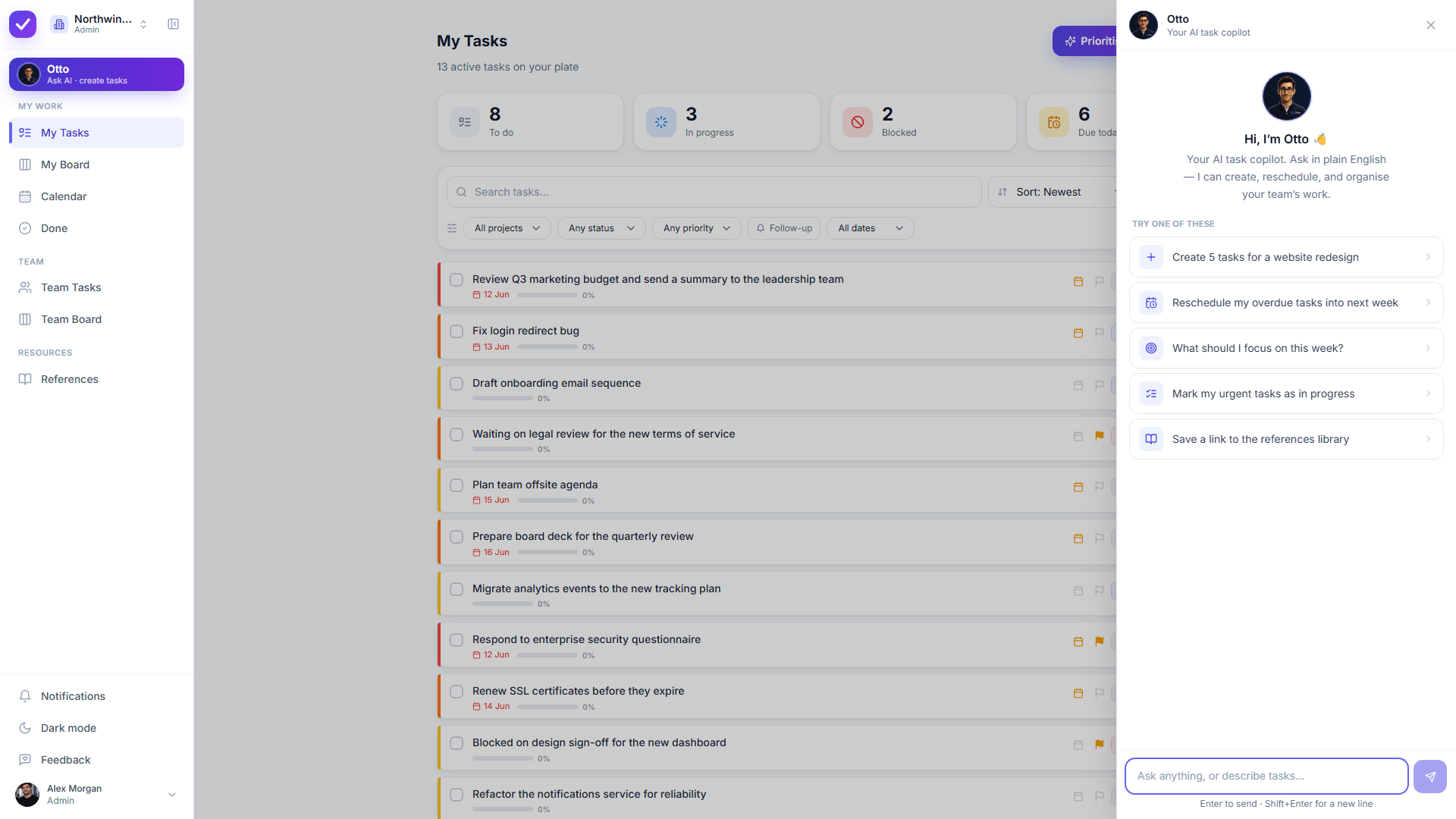
Otto is Taskly's built-in assistant. Describe what needs doing in plain English and Otto drafts, edits and prioritises real tasks behind a diff you approve. It doesn't just suggest; it acts, with your consent.

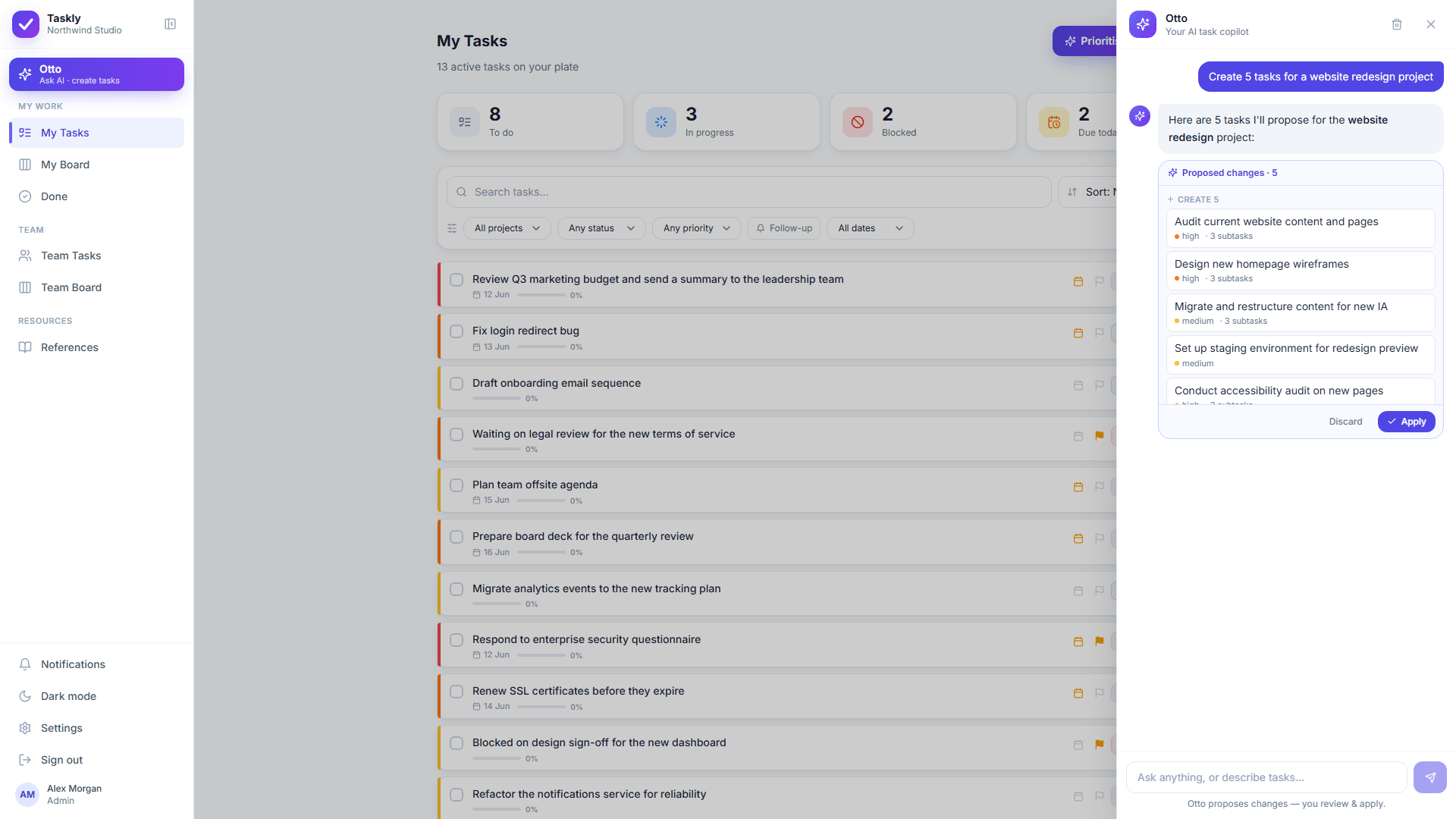
Here's how I'd break that down:
"Create 5 tasks for a website redesign and assign design review to Sarah." Otto proposes the exact tasks (with projects, priorities, due dates, subtasks and assignees) ready for you to apply in one click.


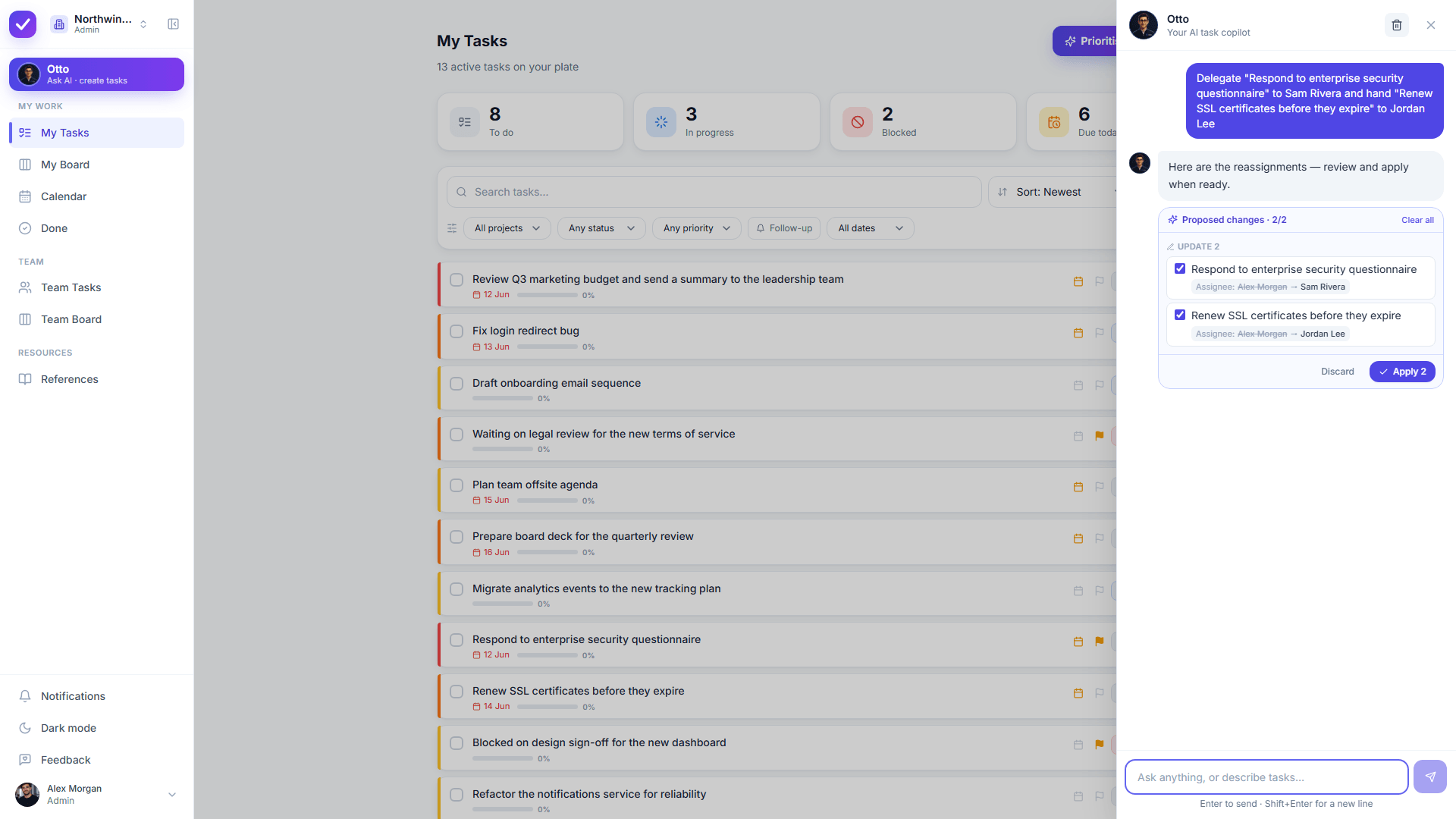
"Move my blocked tasks to in-progress and bump them to high priority." Otto shows a clean before→after preview for every change. You Apply or Discard: nothing happens behind your back.
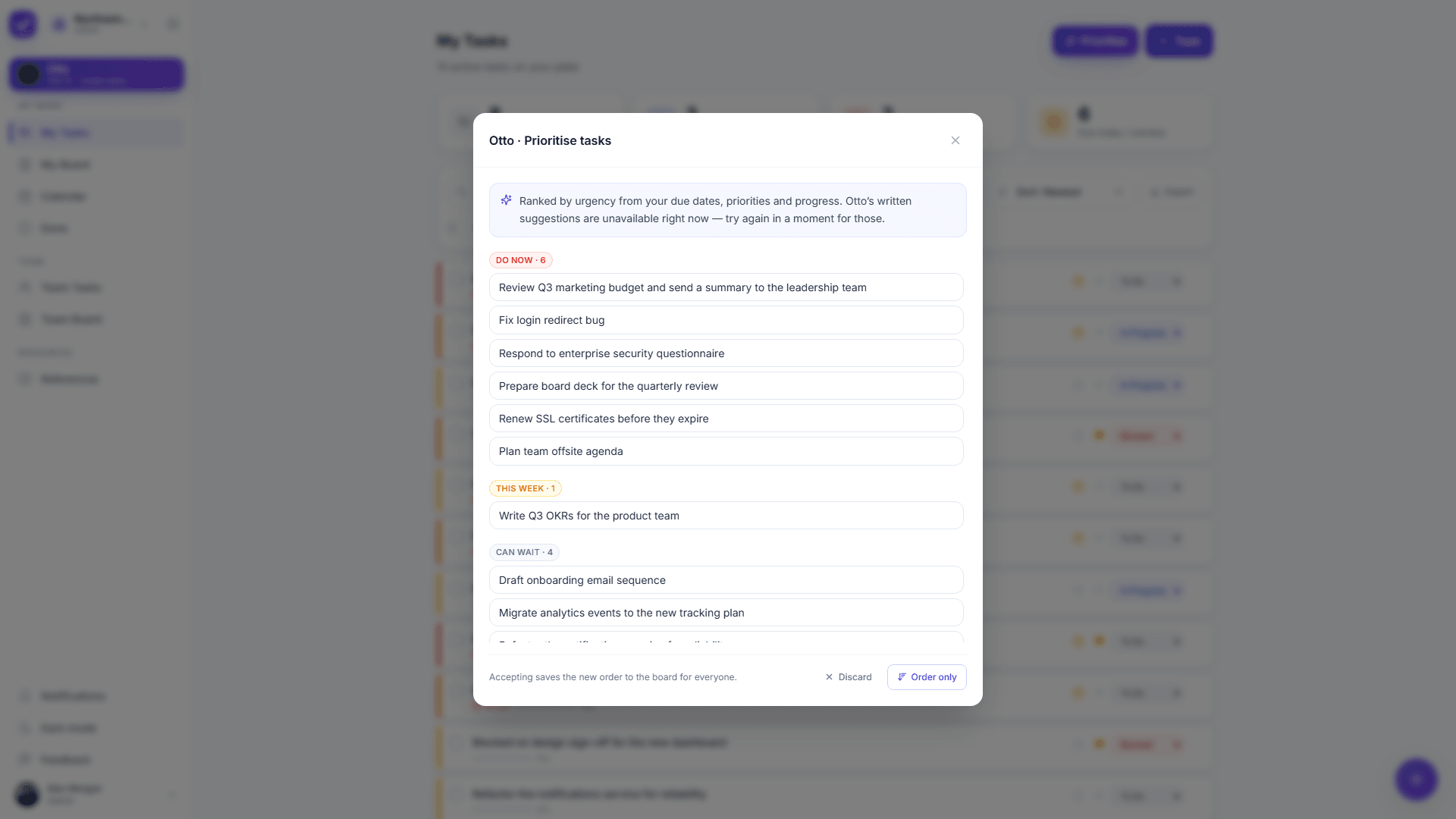
Hit Prioritise and Otto ranks your whole list by urgency (weighing due dates, how much work is left, status and age), then groups it into Do now · This week · Can wait · Reconsider, and proposes due-date and delegation changes.


Ask Otto to assign or delegate and the task moves into the right teammate's bucket, never yours by accident. Admins keep oversight through Team views, so nothing gets lost in the handoff.
No syntax to learn. Type like you'd message a teammate.
“Create 5 tasks for a website redesign and assign design review to Sarah”
“Add 3 onboarding tasks for a new team member”
“Mark my urgent tasks as in progress”
“What should I prioritise this week?”
“Break this task into subtasks”
“Save this link as a reference: https://…”
Otto is built to be trusted: bounded, consent-gated, and private even from the model.
Unnamed teammates get stable pseudonyms, and real addresses never leave your workspace.
Otto proposes a reviewable before→after diff. Nothing is created or edited until you Apply.
Every action runs on the server and is re-validated against your workspace permissions.
≤30 creates, ≤50 updates, ≤20 references per request, plus triage cooldowns.
Otto is good at turning what you say into structure. It is not good at knowing what you never told it, and no assistant is.
| The job | Otto | You |
|---|---|---|
| Turning a sentence into tasks | Otto drafts them | You approve or discard |
| Breaking a big task into subtasks | Otto proposes the breakdown | You correct what it misread |
| Deciding what matters most | Otto orders by dates and stated priority | You know which client actually matters |
| Reassigning work across the team | Otto prepares the change in bulk | You confirm before anything moves |
| Doing the work itself | Otto cannot | Entirely yours |
Otto is the AI assistant built into Taskly, a task manager for teams. Otto turns plain-English requests into real tasks, subtasks, priorities, due dates and assignments, and presents every change as a before-and-after diff you approve before anything is saved. Otto is not a chatbot bolted onto a to-do list: it edits the actual work.
Otto never changes anything without asking, which is the central design decision in Taskly. Every action Otto takes, whether it touches one task or fifty, appears first as a reviewable diff showing exactly what will be created, edited, reprioritized or reassigned. You click Apply, or you discard the whole proposal.
Otto never receives teammate email addresses. Taskly substitutes stable pseudonyms before anything reaches the AI model, so Otto can assign work to the right person without their real address ever leaving the workspace. Every action Otto takes is also re-validated server-side against your workspace permissions.
Otto handles creating tasks from a description, breaking a task into subtasks, reprioritizing a list, rescheduling work, assigning tasks to teammates, applying bulk edits across many tasks at once, and filing reference links. Requests work in plain English, phrased the way you would say them to a colleague.
Otto cannot know context that was never written down, cannot judge which work genuinely matters most to your business, and cannot do the work itself. Otto organizes the plan. The writing, building and shipping underneath it stays with you, and a well-organized backlog is not the same as progress.
Otto works within hard caps on every request: up to 30 task creations, 50 updates and 20 reference links, plus cooldowns on repeated triage. The caps exist so a single misread instruction cannot rewrite an entire workspace, and so the diff you review stays small enough to actually read.
Otto is included in Taskly at no additional cost while Taskly is in early access, with no separate AI add-on and no monthly cap on requests beyond the per-request safety limits. Several competing tools price their AI as a paid extra on top of an already paid plan.
Otto differs on two axes. It drafts real, structured work rather than suggesting text you still have to reshape by hand. And it is consent-gated by default: it proposes, you dispose. Tools that act automatically are faster right up until they are wrong, at which point you are undoing changes you never made.
Start free and let Otto draft your first project in seconds.
No credit card · Sign in with Google or email