
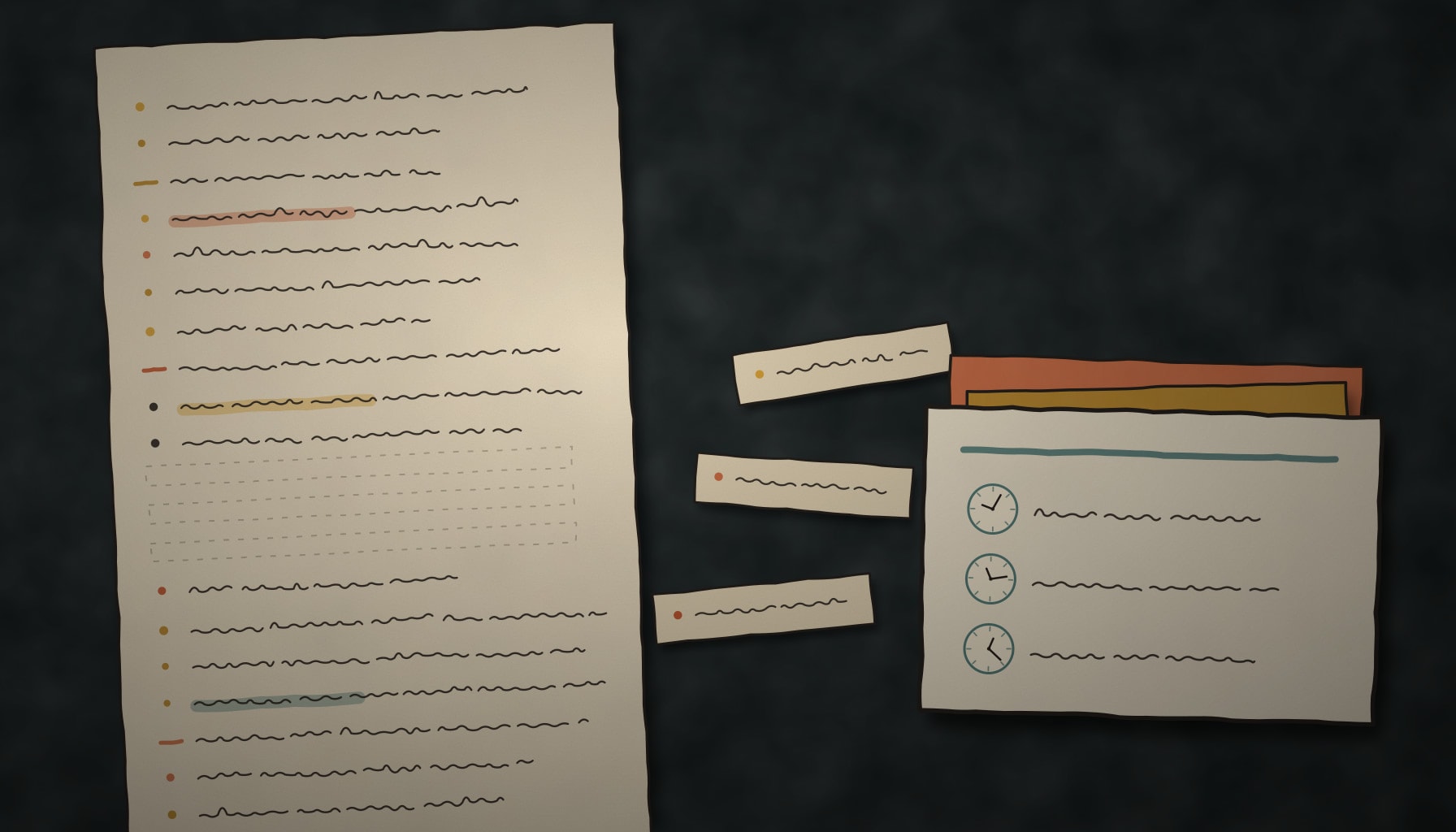
To turn a brain dump into a to-do list, work through it in five passes rather than one. Write everything down in one sitting, with no sorting. Split any line that holds more than one action. Replace anything vague with the first physical step you could take on it. Give the few items you will do today a time and a place. Then say plainly which items are not happening this week. The dump is only the first pass, and the pass almost everyone stops at. Writing it down is what makes the list honest. Naming when and where each item happens is what makes the overwhelm stop.
That distinction is the whole argument of this page, and it is the one most advice on brain dumping leaves out. The advice usually ends where the writing ends, as though the relief came from the emptying. It does not. The research on unfulfilled goals is specific about which step does the work, and it is the planning step, which is why a brain dump can feel wonderful for an hour and leave you exactly as stuck by the evening.
The method, in five passes
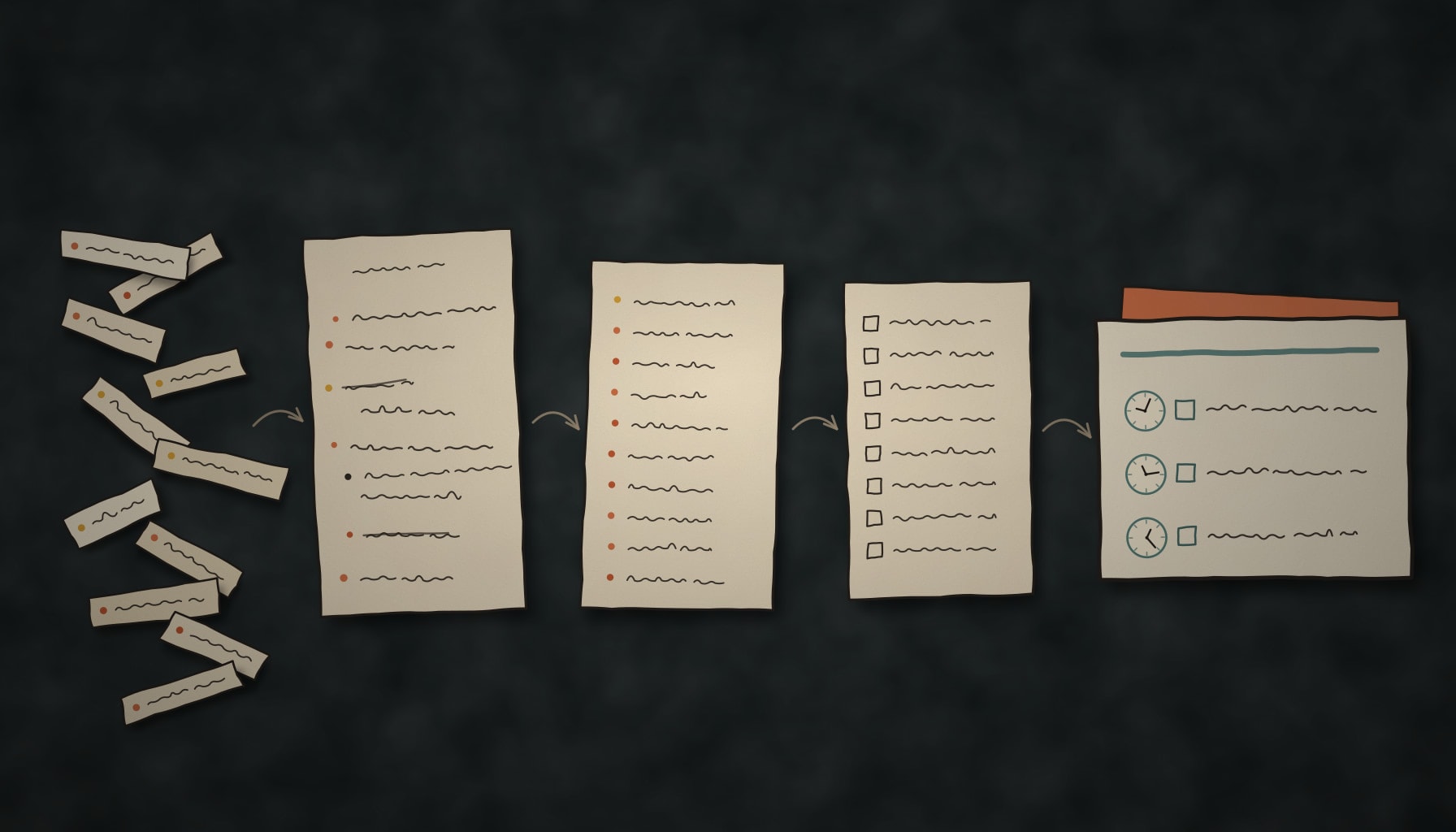
Turning a brain dump into a to-do list is a sequence, and the order is load-bearing: each pass is only cheap because the pass before it already happened. Five passes, each argued in full below:
- Pass 1, get it out. Everything, in one sitting, unsorted and badly written. The dump is the input, not the output.
- Pass 2, split. Any line holding two actions becomes two lines. “Sort the invoices” is usually four things wearing one coat.
- Pass 3, make it startable. Every vague line is replaced by its first physical step. Not the goal, the first movement.
- Pass 4, when and where. The handful you will actually do today get a time and a place attached. This is the pass that ends the overwhelm.
- Pass 5, name the dead. Out loud, as a decision: these are not happening this week, and these are not happening at all.
None of the five passes needs an app, a method or a subscription. Passes one to three are mechanical and take about twenty minutes between them. Pass four takes two minutes and is the one people skip. Pass five takes nerve rather than time.
Pass 1: get it out, badly, in one sitting
The first pass of a brain dump has one rule, and the rule is that nothing gets sorted while you write. No categories, no dates, no priorities, no neat phrasing. Write “that thing with the landlord” if that is what it is called in your head, because the moment you stop to write it properly you have switched from emptying to editing, and editing is slow enough that most people never finish the emptying.
Set a timer for twenty five minutes for a backlog that has built up over months, or ten for a weekly sweep. A brain dump needs an end, or it becomes an afternoon. If items are still arriving when the timer goes, write one line saying more is coming and stop anyway: a complete-feeling list you finished beats a perfect list you abandoned.
Prompts help more than a blank page, because memory does not volunteer things on request. Go through them in order and write whatever each one shakes loose: work in progress, work you are waiting on someone for, money, admin and paperwork, your home, your health, people you owe a reply, promises you made out loud, and anything you have thought about twice this week and done nothing about. That last prompt is usually the most productive one.
Pass 2: split anything holding more than one action
The second pass of a brain dump is the mechanical one, and it is where a list of twenty becomes a list of thirty five. Read each line and ask whether one physical action finishes it. If the answer is no, the line is a project pretending to be a task, and it needs to be split.
“Do the tax return” is not a task. “Find last year’s return in the email archive” is a task, and the four lines after it are also tasks. “Sort out the website” is not a task either, and splitting it is how you find out that three of its four parts are waiting on someone else and the fourth takes ten minutes.
A longer list after this pass is the correct outcome, and it is worth saying plainly because it feels like the wrong direction. Thirty five startable lines is a lighter object to carry than twenty vague ones, because every vague line is a decision you are still holding. The list got longer and the load got smaller.
Pass 3: replace every vague line with a first physical step
The third pass of a brain dump turns the remaining fog into movement. For each line, write the first thing your hands would do. Open the file. Find the email. Text the number. Put the document in the envelope. If you cannot name the first physical step, that is information: the item is either not really yours, or you are missing something you need before you can start, and both of those are better written down than left as a vague sense of dread.
Two markers are worth adding during this pass, because they prevent a specific kind of self-blame later. Put a mark against anything blocked on another person, so that it reads as waiting rather than as failure. And flag, rather than guess at, anything too vague to interpret, including when something else did the dump for you: a tool inventing plausible detail in your list is worse than a tool admitting it cannot tell what you meant.
Pass 4: give today’s few items a when and a where
The fourth pass of a brain dump is short, and it is the pass that does the thing you did the dump for. Take three items, no more, and attach a time and a place to each one. Not “today”. “At 9:30, at the kitchen table, I open the tax folder.” Three lines, each with a clock and a location.
Three is not a round number chosen for neatness. Three is roughly what fits in a working day once meetings, interruptions and the two emergencies you cannot see yet have taken their share, and a plan that assumes none of those is a plan you will have abandoned by eleven. Pick one of the three small enough to finish in twenty minutes, so the day has a floor under it.
The rest of the list is not deleted by this pass and is not a judgement on you. The rest of the list is simply not today, which is the distinction a single undifferentiated list destroys and a short dated one restores. The three-thing day is the same mechanism applied as a standing habit rather than as a one-off rescue.
Pass 5: say out loud what is not happening
The fifth pass of a brain dump is the one nobody wants, and it is the reason the dump holds up for more than a week. Go through what is left and sort it into three piles out loud: this week, later with a real date attached, and not happening. The third pile is the point.
An item you have carried for three weeks without starting is rarely a scheduling problem. It is usually one of four things, and each has a different move: too big, which means it goes back to pass two; not actually yours, which means it needs a conversation, not a slot; not actually important, which means delete it; or blocked on a person you have not chased, which means the real task is the chase. Leaving it on the list is the only option that is not a move.
Deleting an item is allowed to feel like a loss. The alternative is a list with a permanent layer of sediment at the bottom, and a list you have stopped believing is a list you have stopped reading.
The worksheet, to copy
The whole method fits on one page. Copy this into whatever you are using, paper or app, and work top to bottom. The five passes are in order for a reason: skipping to pass four over an unsplit, vague list is how a brain dump turns into a planning session with nothing to show.
PASS 1. DUMP (timer: 25 min for a backlog, 10 min for a weekly sweep)
No sorting, no dates, no tidy wording. Work through the prompts:
  work in progress / waiting on someone / money / admin and paperwork /
  home / health / replies I owe / promises I made out loud /
  anything I have thought about twice this week and not done
STOP when the timer goes, even if more is coming.

PASS 2. SPLIT
For each line: does ONE physical action finish it?
  No  -> it is a project. Write out its separate actions, delete the original.
  Yes -> leave it.
Expect the list to get LONGER here. That is correct.

PASS 3. MAKE IT STARTABLE
For each line, write what your hands would do first:
  "do the tax return"  ->  "find last year's return in the email archive"
  "sort out the website"  ->  "list the 3 broken pages"
Add [WAITING] to anything blocked on another person.
Add [VAGUE] to anything you cannot turn into a first step. Do not guess.

PASS 4. WHEN AND WHERE (this is the pass that stops the overwhelm)
Pick THREE for today. One of the three finishes in 20 minutes.
Write each as: at <time>, at/in <place>, I <first physical step>.
  1. at ____, at ____, I ____
  2. at ____, at ____, I ____
  3. at ____, at ____, I ____
Everything else is not today. It is not deleted and it is not a failure.

PASS 5. NAME THE DEAD
Sort what is left, out loud, into:
  THIS WEEK (real day attached)
  LATER (real date attached, not "someday")
  NOT HAPPENING (delete it now)
Anything carried 3 weeks without starting is: too big (back to pass 2),
not yours (have the conversation), not important (delete), or blocked
(the chase IS the task).

NEXT SWEEP: ____________  (weekly, 10 minutes)
Why your head cannot hold the list, with a number
A brain dump works partly because the alternative is worse than people assume. The popular figure for how much you can hold at once is seven, from Miller in 1956, and the more careful modern estimate is considerably smaller. Cowan reviewed the evidence and put the central limit at about four.
“A single, central capacity limit averaging about four chunks is implicated along with other, noncapacity-limited sources.”
Four is the relevant number for a brain dump because it is roughly how many open loops you can keep in view at once, and a person who feels overwhelmed is typically carrying twenty or thirty. The arithmetic is not close. No amount of discipline closes a gap of that size, which is why the first pass of a brain dump is not a productivity trick so much as an admission about hardware.
Why the dump alone leaves the noise on
Here is where most brain dump advice stops, and where the evidence says the method is only half done. Unfinished goals do not sit quietly. Masicampo and Baumeister activated unfulfilled goals across five experiments and found that unfinished goals produced intrusive thoughts during an unrelated reading task, made goal-related words unusually accessible, and worsened performance on an unrelated anagram task. Then they tested what switched it off.
“Allowing participants to formulate specific plans for their unfulfilled goals eliminated the various activation and interference effects.”
Read that sentence next to what a brain dump actually produces and the gap is obvious. A brain dump produces a list of unfulfilled goals, which is the condition that generates the interference, not the thing that resolves it. The paper’s own framing is that “once a plan is made, the drive to attain a goal is suspended”, and the authors note the reduction was mediated by how earnest the plans were: the participants who later executed their plans were the ones who stopped having intrusions.
So a dump with no plan attached is a list of open loops you can now see, which is better than not being able to see them and is not the same as relief. The relief is a specific commitment about a specific item, which is pass four, which is the pass that takes two minutes and gets skipped.
Why “when and where” is the part that works
Pass four has a name in the research literature. An implementation intention is a plan in the form “when situation X arises, I will perform response Y”, as distinct from a goal intention, which only names the outcome. The difference between the two is measurable and it is not small. Gollwitzer and Sheeran meta-analysed the evidence and reported that “findings from 94 independent tests showed that implementation intentions had a positive effect of medium-to-large magnitude (d = .65) on goal attainment” (Advances in Experimental Social Psychology, 2006).
An effect of that size, from the single act of attaching a trigger to an intention, is the best return available anywhere in this method. It is also why pass four insists on a clock and a location rather than a priority flag. “High priority” is a goal intention wearing a badge. “At 9:30, at the kitchen table” is a trigger, and a trigger is the thing the 94 tests were measuring.
This is the practical reason to resist the urge to date the whole list. Thirty dated items is thirty triggers competing for the same day, which produces no triggers at all. Three real ones outperform it, and the rest of the list is waiting, undated and harmless, for the next sweep.
Your list is probably not too long
One widely repeated claim deserves pushing back on, because acting on it wastes an afternoon. The idea that a long list paralyses you by offering too many choices is weaker than its popularity suggests. Scheibehenne, Greifeneder and Todd gathered the choice overload literature and tested it.
“In a meta-analysis of 63 conditions from 50 published and unpublished experiments (N = 5,036), we found a mean effect size of virtually zero but considerable variance between studies.”
That finding does not mean a long list is pleasant. It means that length is the wrong variable to attack first, and the right one is whether each item can be started. Steel’s meta-analysis of procrastination, built on 691 correlations, found that “strong and consistent predictors of procrastination were task aversiveness, task delay, self-efficacy, impulsiveness” along with conscientiousness and its facets (Psychological Bulletin, 2007). Aversiveness and low self-efficacy are precisely what a vague line produces: you cannot picture starting it, so reading it feels bad, so you look away.
The practical version: rewriting ten vague items into startable ones will do more for the feeling of overwhelm than deleting thirty items will. Pass three is the high-value pass. Pruning is pass five, and it is housekeeping rather than rescue.
“I am overwhelmed, where do I start”
If you are reading this while overwhelmed and the five passes feel like one more project, the answer to where to start is narrower than the method above. Start here, in this order, and stop at the end of it.
- Ten minutes, everything out. Not the full backlog. Whatever is loud right now. Loud is a good enough filter when you are overwhelmed.
- Circle the three loudest. Not the most important. The three that are taking up the most room in your head, which is a different and more honest question.
- Write the first physical step for each of the three. If a first step will not come, that one is blocked or not yours, and it goes to the bottom with a mark on it.
- Give one of them a time today. One. With a place. The other two can wait for tomorrow’s version of this.
That is twelve minutes and it is deliberately not the whole method. Overwhelm is a bad state in which to do systems work, and the goal of the short version is to get you out of it far enough that the full five passes become possible later in the week, not to fix the backlog today.
What the research actually supports, and what it does not
Brain dumping is surrounded by confident claims, most of which trace back to a blog quoting a blog. Here is what each step of this method rests on, with the primary paper named so you can check it rather than take it from here.
| The claim | What the primary source says | Source and year |
|---|---|---|
| You cannot hold the list in your head | Central short-term capacity averages about four chunks, not seven | Cowan, Behavioral and Brain Sciences, 2001 |
| The dump alone does not quiet it | Unfinished goals caused intrusive thoughts and interference across five experiments; specific plans eliminated the effects | Masicampo and Baumeister, Journal of Personality and Social Psychology, 2011 |
| A when and a where is the high-value step | Medium-to-large effect on goal attainment, d = .65, across 94 independent tests | Gollwitzer and Sheeran, Advances in Experimental Social Psychology, 2006 |
| A long list is not itself the problem | Mean effect of choice overload was virtually zero across 63 conditions from 50 experiments, N = 5,036 | Scheibehenne, Greifeneder and Todd, Journal of Consumer Research, 2010 |
| Vague items are what stall you | Task aversiveness, task delay, self-efficacy and impulsiveness were the strong and consistent predictors of procrastination across 691 correlations | Steel, Psychological Bulletin, 2007 |
| The term “brain dump” itself | Described as a “mind sweep”: collecting every open loop in one pass before processing any of it | Allen, Getting Things Done, 2001 and revised 2015 |
What the research does not support is any specific number for how much time a brain dump saves, how many items a person should keep, or how much faster you work afterwards. Those numbers circulate widely and none of them traces to a study that measured it, so no figure of that kind appears on this page.
Five ways a brain dump goes wrong
Each of these is common enough to be worth naming, and each has a one-line fix. Four of the five are failures of a later pass, not of the dump itself.
| What happens | Why it happens | The fix |
|---|---|---|
| It felt great, then nothing changed | The dump stopped at pass one, so the list is open loops you can now see | Two minutes on pass four. Three items, each with a time and a place |
| The dump became a filing session | Sorting started before the emptying finished | Timer on, no categories, no dates until the timer goes |
| The list is longer and worse | Pass two ran but pass three did not, so you now have more vague items | Rewrite each line as a first physical step before judging the list |
| The same five items are still there in November | Pass five never happened, so nothing is ever formally dead | Sort out loud into this week, later with a date, and not happening |
| The paper dump never reached the app | Pass one happened somewhere the later passes cannot be done | For a long list, dump it where it will live, since passes two to five are edits |
How often to do a brain dump
A full brain dump is a reset, not a routine, and treating it as a weekly ritual is how it becomes a chore you skip. The pattern that holds: one full dump when things have genuinely got away from you, then a ten minute sweep once a week to catch what has accumulated, then another full dump only when the weekly sweep starts feeling inadequate again.
The weekly sweep is a shorter version of the same five passes, and in practice it is mostly passes four and five. New items arrive with their context still fresh, so they need less splitting, and the real work is deciding what this week holds and admitting what last week quietly dropped. Fifteen minutes on a Friday or a Sunday does it.
One sign worth watching for: if a full dump is needed more than every couple of months, the problem is upstream of the dump. Items are not reaching the list when they arrive, and the fix is capture, not another reset. A few habits around capture cost less than a quarterly rescue.
Doing the brain dump with an AI assistant
Passes two and three of a brain dump are mechanical, dull and exactly the kind of rewriting an AI assistant is reliably good at. Hand it the raw dump and ask for the transformation rather than for advice: one line per task, projects replaced by a first physical step, a mark on anything blocked on another person, and a flag rather than a guess on anything it cannot interpret.
Two things are worth keeping for yourself. Pass four, the three items with a time and a place, is a judgement about your day that a model does not have the information to make, and handing it over produces a confident plan built on nothing. Pass five is a decision about what you are giving up, which is not a task you can delegate.
The other limit is about where the finished list lives. A chat window is a thinking surface rather than a store, and our piece on using ChatGPT as a to-do list goes through what OpenAI’s own documentation says about memory, reminder caps and connected apps, which is the detail that decides whether a chat-based list survives past a fortnight.
Where Taskly fits
Taskly was built so that passes two and three happen inside the list rather than in a separate window, and so that the result is the list itself rather than a message about the list.
- The whole dump goes in at once. Paste or dictate the mess and ask Otto to split it, turn the projects into first steps, and propose dates. That is passes two and three, done as edits to the real list.
- Nothing changes without your approval. Otto proposes every change as a before and after that you accept or discard, so a hundred-line dump being restructured is still a decision you make rather than something that happens to your list.
- Today is a separate view. The three items with a time attached are not buried in the other thirty, which is the whole point of pass four.
- The weekly sweep is one request. “Move everything I did not finish to Thursday” is one approval rather than twenty edits.
- Ready for two. A shared list for a household or a client works without a team pricing story attached.
What Taskly cannot do, plainly. Taskly has no offline mode, so a brain dump on a plane happens on paper. There are no native mobile apps yet, so Taskly runs in a browser. There is no calendar layout, so if pass four only clicks for you when you can see the day as a timeline, Taskly is not that and a visual planner will serve you better. The integration surface is small, so Taskly will not pull a dump out of ten other tools for you. And Otto is a good rewriter rather than an oracle: it will split and restructure what you gave it, and the judgement about which three things matter today stays yours, which is as it should be.
If the assistant part is what you are weighing, the AI to-do list page covers what to check before trusting any tool with your list, and what an AI task manager is covers the category rather than the product.
The short version
A brain dump is worth doing and is not the method. Get everything out in one timed sitting with no sorting, split every line that holds two actions, rewrite every vague line as the first physical step your hands would take, then give three items a clock and a place and say out loud which items are not happening. The writing down is what makes the list honest, and the evidence is clear that the plan is what stops the noise: unfinished goals interfere until a specific plan exists, and attaching a when and a where to an intention carries a medium-to-large effect on whether it actually happens. If the list still feels unmanageable afterwards, the problem is almost never that it is long. It is that its items cannot be started.
Frequently asked questions
How do I turn a brain dump into a to-do list?+
What is a brain dump?+
Why do I still feel overwhelmed after a brain dump?+
How long should a brain dump take?+
Should a brain dump be on paper or in an app?+
What do I do with the items I am never going to do?+
Does a shorter to-do list reduce overwhelm?+
Can I ask an AI to turn my brain dump into a to-do list?+
Every figure on this page was read in the primary paper on 19 October 2026, and the method itself carries no invented numbers. Where a popular claim about brain dumping had no primary source behind it, the claim was left off this page rather than softened.