The Jira alternative for small teams, with AI that asks first
Jira is built for large software programs, and its AI reflects that: Rovo is not on the Free plan at all, and a Standard seat includes 25 Rovo credits a month when one basic Rovo Chat answer costs 10. Taskly gives a small team real structure (boards, subtasks, recurrence and a true team model) with no schemes, no JQL and no admin, plus Otto, an AI that drafts the work and waits for your approval. Included, never metered, free while in early access.
Written by Saba Majidi, Founder, Taskly·Last reviewed
AI that asks first
An AI with no allowance to run down
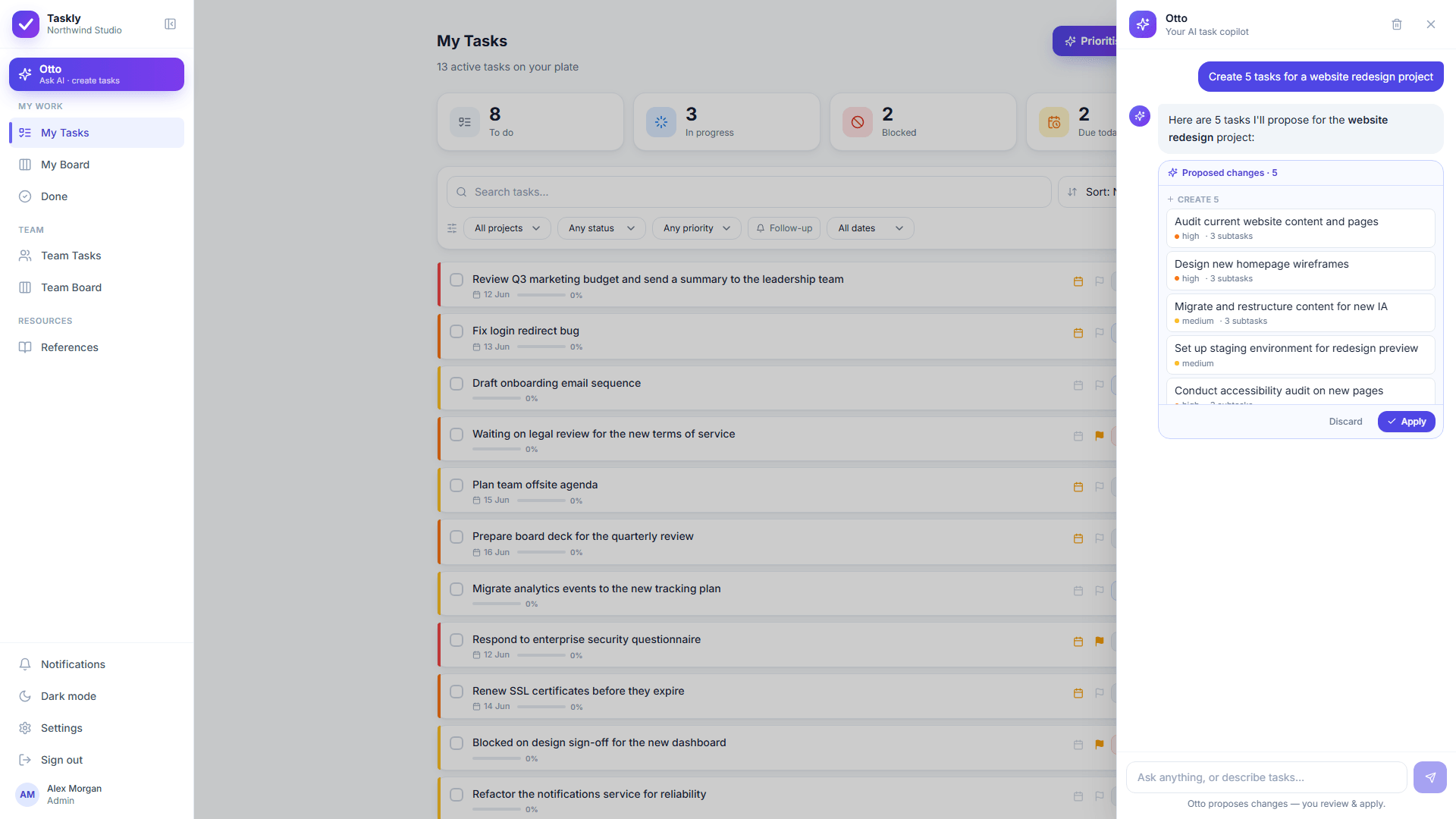
Rovo is capable, and Rovo is budgeted. Atlassian includes 25 Rovo credits per user a month on Jira Standard and 70 on Premium, pooled across the organization and reset monthly with nothing carried over, while a basic Rovo Chat answer is a flat 10 credits and the deeper modes and Jira agents cost a variable amount more. Otto works differently in two ways that matter to a small team. Otto is part of Taskly, so there is no allowance to watch, nothing to top up and no AI tier to reach first. And Otto does not act on its own: describe the work the way you would say it out loud, and every change Otto proposes, one task or fifty, arrives as a before and after you approve or discard.
Otto proposes. Nothing is created, moved or reassigned until you approve it.
Why teams look for a Jira alternative
•
Jira usually needs a dedicated admin and real configuration before Jira is useful to a small team.
•
Rovo, Jira’s AI, is not available on the Free plan at all. Rovo starts on Standard.
•
Rovo is metered by credit. Standard includes 25 Rovo credits per user a month and Premium 70, pooled across the organization, and they do not roll over.
•
A basic Rovo Chat answer costs 10 credits, so a Standard seat covers two of them a month before it starts drawing on a teammate’s share.
•
Rovo cannot even be switched on unless an org admin is on a verified business domain, which rules out teams still running on a gmail.com or outlook.com address.
•
Boards sit under workflows, schemes, epics and JQL that most small teams never need.
•
The Free plan caps at 10 users and 100 automation rule runs a month across the whole site, and limits permissions, roles, audit logs, email notifications and apps.
Taskly as your alternative
Taskly is the lightweight, AI-native alternative to Jira for small teams that want real structure (Kanban boards, subtasks, recurring tasks and a true team model) without the schemes, JQL, admin overhead or a metered AI. Describe what needs doing in plain English and Otto drafts the tasks for you to review. Most teams are organized in minutes rather than weeks, Otto is included rather than allowanced by the credit, and the whole product is free while Taskly is in early access.
Side by side
Taskly vs Jira
Taskly
Jira
Setup time
Minutes: no config, no admin role needed
Days to weeks, and usually a Jira admin to own it
Learning curve
Open it and type
Steep: workflows, schemes, permission schemes and JQL
AI assistant
Otto creates and edits real tasks from plain English, behind a diff you approve
Rovo: chat, search, agents in Jira and a coding agent, capable and metered by credit
What the AI costs
Otto is included: no tier to reach, no credits, no per-seat AI charge
Rovo is not on Free at all. Standard includes 25 credits per user a month, Premium 70, Enterprise 150 (2026)
What that buys
Unlimited requests, with the same approve-diff on every one
A basic Rovo Chat answer is 10 credits, so a Standard seat covers two a month; deeper modes cost a variable amount more
When the AI runs out
It does not: there is no allowance to exhaust
Admins are warned at 80% and 100%; from 3 December 2026 extra usage is billed at $10 per 1,000 credits, or AI pauses if extra usage is off
Who can turn the AI on
Anyone with a Taskly account, on any email address
Rovo needs an org admin on a verified business domain; Atlassian will not enable Rovo on gmail.com or outlook.com
Structure
Lists, Kanban, subtasks, recurrence, out of the box
Very deep (epics, sprints, story points), often more than a small team needs
Team model
Every task in one owner’s bucket, plus admin Team views
Powerful, and built on permission schemes someone has to design
Free plan limits
The whole product, Otto included, while in early access
Up to 10 users, 2GB storage, 100 automation rule runs a month site-wide, no Rovo, limited permissions and audit logs (2026)
Privacy
Teammate emails are never sent to the AI model
Standard SaaS data handling
Entry price
Free during early access, Otto included
Free up to 10 users, then per-seat on Standard and Premium; Enterprise is annual only
Taskly is free for the whole product, Otto included, while in early access. Checked against Atlassian’s own plan and licensing pages on 10 September 2026: Jira has a Free plan for up to 10 users with 2GB of file storage, 100 automation rule runs a month across the whole site and no Rovo AI, then Standard (250GB storage, 1,700 automation rule runs a month, roles, permissions and audit logs) and Premium (unlimited storage, 1,000 automation rule runs per user a month pooled, advanced planning, a sandbox and a 99.9% uptime SLA), with Enterprise sold on an annual contract only. Atlassian prices Standard and Premium per user on a progressive scale, so the unit price falls as you add seats, and on monthly subscriptions the bill is based on the highest seat count at any point in the cycle. Atlassian’s pricing page renders its per-seat figures in the browser and none could be verified in this pass, so this page does not quote one: check the Jira pricing page for current rates. On the AI side, Rovo credits are included with paid plans at 25 per user a month on Standard, 70 on Premium and 150 on Enterprise, pooled across the organization, reset monthly and not carried over, with extra usage listed at $0.01 per credit or $10 per 1,000 from 3 December 2026.
See it
What you get instead of Jira
app.ottotaskly.com
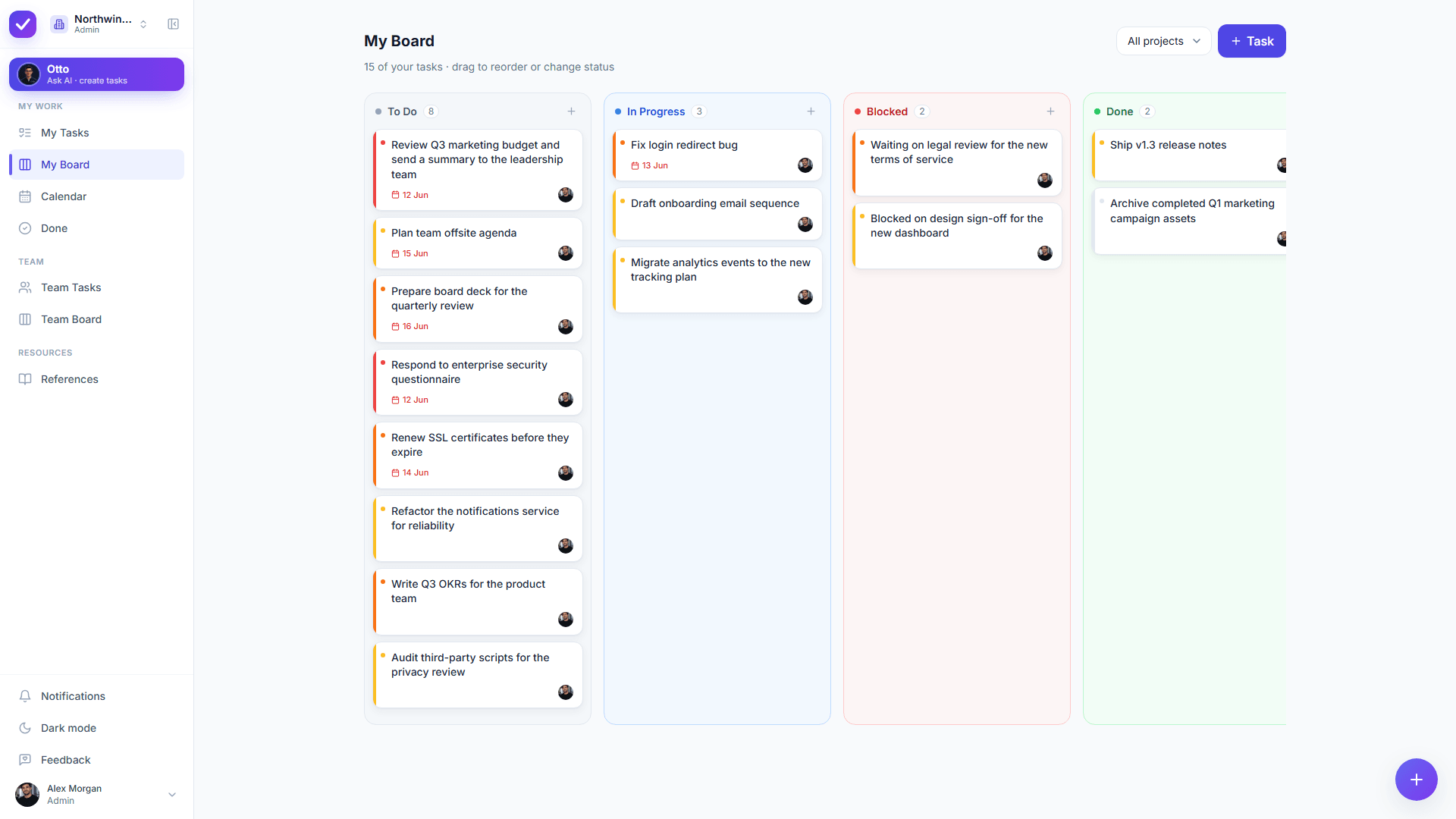
A board that works on day one: To-Do, In-Progress, Blocked, Done, with no workflow, scheme or board configuration in front of it.
app.ottotaskly.com
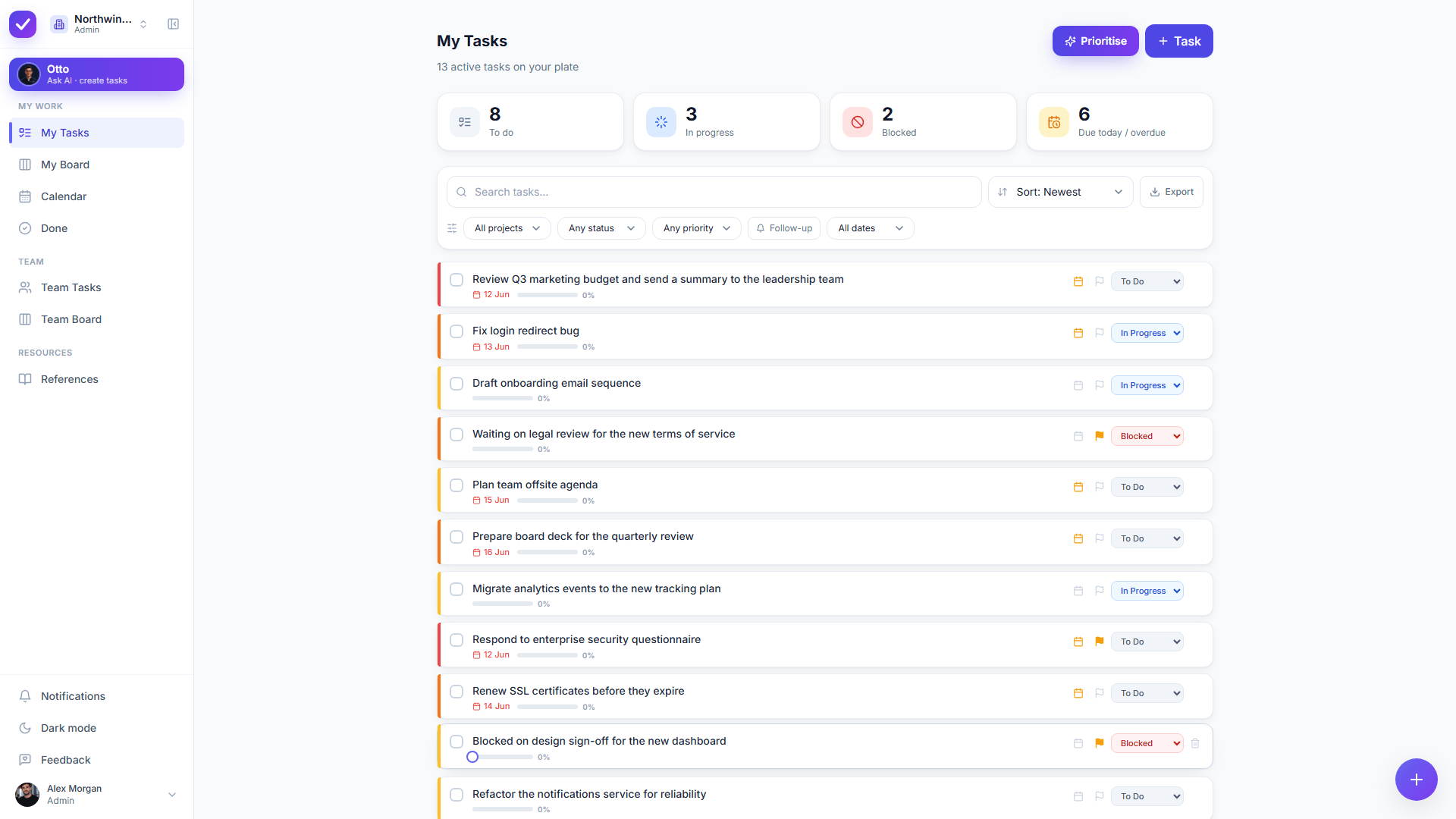
One person’s day in one bucket, without writing a JQL filter to get there.
app.ottotaskly.com
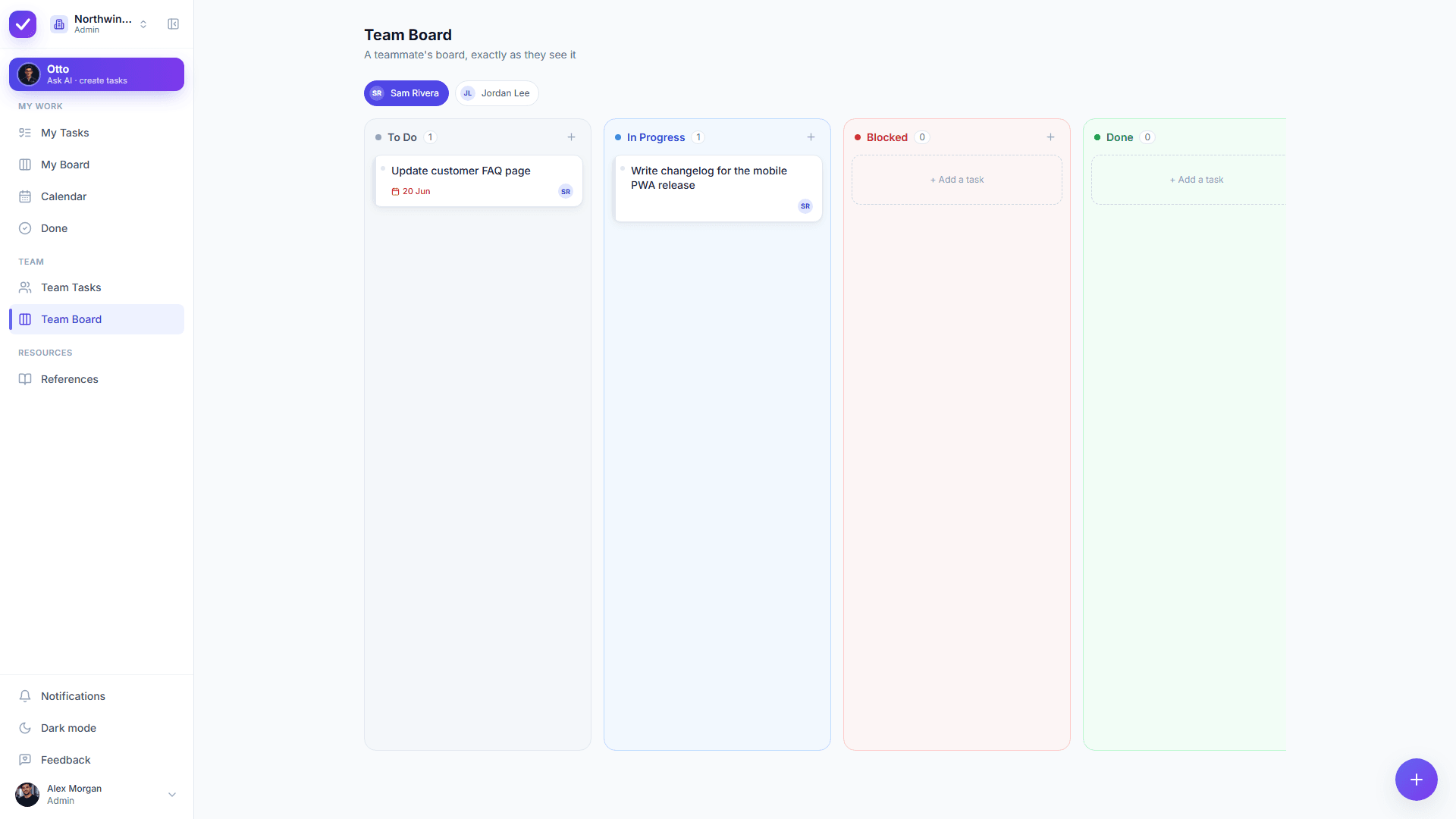
Admin Team views answer who owns what, without a permission scheme to design first.
Choose Taskly if…
Jira feels like overkill and you spend more time configuring than working.
You are a small team on Jira’s Free plan, which means you have no AI in Jira at all.
You do not want the AI budgeted by the request, or to find out on a Thursday that the credits ran out.
Your team is cross-functional (ops, marketing, agency, founders), not just engineers.
You want an AI that does the organizing and lets you approve every change before it happens.
You want to be productive today, for free, with nothing to configure.
Jira is the better choice if…
• You are a software team that lives in sprints, epics, story points and advanced agile reporting. Taskly has none of those.
• You need deep developer integrations (Bitbucket or GitHub pipelines, releases, branch links) and JQL queries. Taskly has no JQL and a small integration surface.
• You run scaled agile across many teams and need cross-project planning, a sandbox and an uptime SLA. Taskly offers no SLA.
• You need granular permission schemes, work-item-level security, audit logs and data residency. Taskly’s model is one owner per task plus admin Team views, and that is all of it.
• You want AI that also searches across your other tools, writes code and runs autonomously. Otto only does tasks, and Otto deliberately stops for approval, which is slower by design.
• You are past ten people and already have a Jira admin. Jira’s depth is genuine once someone owns it.
We’d rather be honest than oversell: it’s your team’s call.
Switching from Jira
There is no painful import to plan. Start a Taskly workspace and either recreate your active work in a few minutes, or tell Otto "Create tasks for [project]..." and approve what Otto drafts. Most teams move only their live work, not years of closed tickets, and there are no workflows, schemes or automation rules to rebuild because Taskly does not have them.
FAQ
Jira alternative: questions
What is the best Jira alternative for a small team?+
Taskly is a strong choice for a small team that finds Jira too heavy. Taskly offers boards, subtasks, recurring tasks and a real team model with no configuration and no admin role, plus Otto, an AI assistant that turns plain English into tasks you approve. The point that matters most to a small team is that Jira’s AI, Rovo, is not available on Jira’s Free plan at all and is metered by credit on the paid ones, while Otto is included in Taskly and Taskly is free while in early access.
Does Jira include AI on the free plan?+
No. As of 10 September 2026, Atlassian states that Rovo AI is included on every paid Jira plan (Standard, Premium and Enterprise) but is not available on the Free plan, so a paid plan is the entry point for AI-powered search, chat and agents in Jira. Rovo also has to be turned on by an org admin on a verified business domain, and Atlassian will not enable Rovo on generic domains such as gmail.com or outlook.com. Taskly includes Otto on every account, with no tier and no domain requirement.
How many Rovo credits do you get with Jira?+
Atlassian includes a monthly Rovo credit allowance with each paid Jira seat: 25 credits per user a month on Standard, 70 on Premium and 150 on Enterprise, checked against Atlassian’s own documentation on 10 September 2026. Those credits are pooled across the organization, reset monthly and do not roll over. A basic billable event such as a Rovo Chat quick answer costs 10 credits, while deeper modes, agents in Jira and the Jira Coding Agent cost a variable amount more. From 3 December 2026 usage beyond the allowance is billed, listed at $0.01 per credit or $10 per 1,000. Taskly does not meter Otto at all.
Does Taskly have AI like Jira’s Rovo?+
Taskly has an AI assistant, Otto, with a much narrower job than Rovo. Rovo spans search, chat, agents across Atlassian products and a coding agent, and Atlassian meters it by credit. Otto does one thing: Otto creates, edits, reprioritizes and assigns the real tasks from a plain-English request, and shows every change as a before and after diff you approve before anything is applied. Otto is included in Taskly rather than allowanced, and teammate email addresses are never sent to the AI model.
Can Taskly replace Jira for a software team?+
Taskly can replace Jira for many small software teams: boards, subtasks, recurring work, per-owner task buckets and admin oversight cover what most of them actually use a tracker for. Taskly is the wrong swap for teams that depend on sprints, epics, story points, advanced agile reporting, JQL, granular permission schemes or deep Bitbucket and pipeline integration, because Taskly has none of those. That is worth saying plainly rather than overselling.
Is Taskly cheaper than Jira?+
Taskly is free for the entire product, Otto included, during early access. Jira is free for up to 10 users, without any Rovo AI, and charges per seat above that on a progressive scale that lowers the unit price as you add users. Atlassian’s pricing page renders its per-seat figures in the browser and this page does not quote a number it could not verify on 10 September 2026, so check the Jira pricing page for current rates. For a paying team that also wants AI, Taskly is less expensive today, because Taskly does not charge for Otto or meter it.
When is Jira still the better choice?+
Jira is still the better choice when you run complex agile at scale: sprints, epics, story points, cross-project planning, granular permission schemes, an uptime SLA and deep developer integrations, and you have someone to administer it. That depth is real and Taskly does not have it. Taskly is for small, often cross-functional teams that want structure and an AI that organizes it for them, with no configuration project in front of them.