The daily standup template that is not a status round
Fifteen minutes, blockers and decisions first, and a named plan before anyone leaves. Copy it into a calendar invite or a chat channel. No email, no download.
Written by Saba Majidi, Founder, Taskly·Last reviewed
Quick answer
A daily standup template is a fixed agenda for a short daily team meeting: who speaks, about what, in what order, and for how long. A daily standup template that holds up has four parts: the goal read aloud, one round for blockers and decisions rather than status, one named commitment each for the day, and a parking lot for everything that will not fit in fifteen minutes. The free template below has all four, plus a written variant for teams in different time zones. Copy it and paste it anywhere. Nothing on this page is gated.
Copy this
The 15 minute daily standup template
Select it, copy it, paste it into the recurring calendar invite so the agenda is in front of people before the call starts. The clock marks are a shape for a team of five to eight, so move them to fit yours. The one thing not to move is the ending.
DAILY STANDUP TEMPLATE, 15 MINUTES, LIVE

Same time, same place, every working day. Timebox is hard.

00:00  Sprint goal, read aloud, one line
       "We are trying to ______ by ______."

00:30  Round one: blockers and decisions only
       Each person, 30 seconds, answering only these:
         BLOCKED ON ......... (or "nothing")
         NEED A DECISION .... (or "nothing")
         CHANGED SINCE YESTERDAY, if the plan moved
       If nothing is blocked and nothing changed, say "clear" and pass.

07:00  Round two: today's one commitment
       Each person, one sentence, the single thing they will finish today.
       Not a list. One thing, named specifically enough to be checkable.

11:00  Plan for the next day of work
       Out loud, the facilitator names what the team is doing about each
       blocker: who, with whom, and before when.

14:00  Parking lot
       Read the parking lot list aloud. Nothing is discussed here. Each
       item gets a name and a slot after the meeting.

15:00  Stop. Whether or not you are finished.

WHAT DOES NOT BELONG IN THIS MEETING
  Status for the benefit of a manager who is listening.
  Solving the blocker you just named.
  Anything that involves only two people.
  Demos, design debate, estimation, re-planning the sprint.
The live daily standup template. The missing status round is deliberate, and the reason is two sections down.
If you are spread across time zones
The written daily standup template
A written standup keeps the same four prompts and gives back the fifteen minutes. It also fails in a specific way, which the rules underneath it are there to prevent: without a facilitator reading the posts, a written standup becomes a wall of updates nobody reads.
DAILY STANDUP TEMPLATE, WRITTEN

Post in the team channel by an agreed time. Four lines, no prose.

  BLOCKED ON:      ______________________  (or: nothing)
  NEED A DECISION: ______________________  (or: nothing)
  TODAY:           ______________________  (one thing)
  CHANGED:         ______________________  (only if the plan moved)

Rules that make the written version work
  1. One person facilitates. They read every post within the hour and
     reply under each blocker with a name and a time. Without this the
     written standup becomes a wall nobody reads.
  2. A blocker gets a live conversation, not a thread. The written post
     is for raising it. Two people and ten minutes solve it.
  3. "TODAY" is one item. A list of six is a status report, and a status
     report is the thing you are trying to stop writing.
  4. Keep it in one channel, in one thread per day, so yesterday is
     readable without scrolling.
What the rules actually require
The three questions are not in the Scrum Guide
Almost every daily standup template on the internet is the three questions: what did I do yesterday, what will I do today, what is blocking me. The 2020 Scrum Guide does not contain them. What the Scrum Guide sets out is narrower than most templates assume, and more permissive.
“The purpose of the Daily Scrum is to inspect progress toward the Sprint Goal and adapt the Sprint Backlog as necessary, adjusting the upcoming planned work.”
“The Daily Scrum is a 15-minute event for the Developers of the Scrum Team. To reduce complexity, it is held at the same time and place every working day of the Sprint.”
Team members “can select whatever structure and techniques they want, as long as their Daily Scrum focuses on progress toward the Sprint Goal and produces an actionable plan for the next day of work.”
Source: Schwaber, K., and Sutherland, J. (2020), The Scrum Guide, Daily Scrum. Checked 24 September 2026.
Three things follow from that, and they are what the template above is built on. The timebox is fifteen minutes and it is not a target. The meeting belongs to the people doing the work, and the guide adds that if the Product Owner or Scrum Master are actively working on Sprint Backlog items, they participate as Developers. And the format is explicitly yours to choose, as long as it produces an actionable plan for the next day. A round of status updates is not an actionable plan, which is the argument the next section makes with evidence rather than assertion.
Why most stand-ups go wrong
Three rules, and where each one comes from
Stand-ups are one of the few agile practices that has actually been studied. The findings below come from the same research programme, which observed the meeting rather than surveying opinions about it.
Talk to each other, not to the manager
In the grounded theory study of 79 observed stand-ups across 12 teams, what raised people’s view of the meeting was sharing information with teammates and getting problems discussed and resolved together. What lowered it was status reporting directed at managers. The template above has no status round for that reason: round one asks only what is blocked and what needs deciding.
Fifteen minutes, and the clock wins
The 2020 Scrum Guide sets the Daily Scrum as a 15 minute event, held at the same time and place every working day to reduce complexity. In the research, a perceived duration that was too long was one of the three things that reduced satisfaction. Stop at 15 minutes even mid sentence. The unfinished thing goes in the parking lot, which is what the parking lot is for.
End with a plan, not with everyone having spoken
The Scrum Guide says the purpose of the Daily Scrum is to inspect progress toward the Sprint Goal and adapt the Sprint Backlog, producing an actionable plan for the next day of work. A standup where fifteen people spoke and nothing moved has finished its ritual and skipped its job. That is why the template names, out loud, who is doing what about each blocker and by when.
The scale of the dislike is worth stating plainly, because it is usually treated as a personality problem. Across 102 observed stand-ups and 60 interviews with members of 15 teams in five countries, the researchers found the practice is usually challenging to conduct in a way that benefits the whole team, and that many members have a negative experience of it which reduces job satisfaction, trust in co-workers and wellbeing. The earlier study from the same programme, 79 observed meetings across 12 teams in three companies, named the three factors that lowered satisfaction: status reporting aimed at managers, meeting too frequently, and a perceived duration that was too long. What raised it was sharing information with teammates, and getting problems discussed and resolved together.
Sources: Stray, V., Moe, N. B., and Sjøberg, D. I. K. (2020), Daily Stand-Up Meetings: Start Breaking the Rules, IEEE Software 37(3), 70 to 77. And Stray, V., Sjøberg, D. I. K., and Dybå, T. (2016), The daily stand-up meeting: A grounded theory study, Journal of Systems and Software. Both checked 24 September 2026. The two papers share part of their data, so treat them as one body of work rather than two independent results.
The part people skip
Write the blockers down
A standup that raises a blocker and does not record it will raise the same blocker again on Thursday. The log below is the cheapest possible fix: one row per blocker, an owner, a time, and a column that makes an unresolved row visible. Keep it wherever the team already looks.
PARKING LOT AND BLOCKER LOG

Raised    Who     Blocker or decision needed        Owner   By when   Done
--------  ------  --------------------------------  ------  --------  ----
Mon 09:15 Priya   Waiting on staging credentials    Sam     Mon 14:00  y
Mon 09:17 Alex    Need a call: which API do we use  Alex+PM Tue 10:00  n
Tue 09:12 Sam     Design review not booked          Priya   Tue 17:00  n

How to use it
  Every blocker leaves the meeting with an owner and a time, or it was
  not a blocker. Read the open rows aloud at 14:00 tomorrow. A row that
  is still open after three days is not a blocker, it is a decision
  nobody wants to make, and it needs escalating rather than repeating.
The parking lot and blocker log. The example rows are illustrative, not real data.
Fit
When a daily standup helps, and when it does not
A daily standup template helps if
The team shares a goal for the week or the sprint, so there is something for progress to be measured against.
The work has real dependencies between people, which is what a coordination meeting is for.
There are roughly three to nine people in the room. Bigger than that and the round itself eats the timebox.
Somebody is willing to facilitate: keep the clock, own the parking lot, and stop the first attempt to solve a blocker in the room.
A daily standup template will not help if
People work on unrelated things. A standup between people with no dependencies is a status meeting wearing a better name, and the research is clear about how that lands.
A manager attends to collect updates. The moment the meeting is for them, the round becomes performance, and the honest blockers stop being raised.
The team is fully asynchronous across many time zones. Use the written variant below rather than making somebody take a 22:00 call.
The real problem is that nobody knows what the goal is. A daily standup will surface that every morning and fix it on none of them.
The part you can hand over
The plan the standup produced, captured before 11am
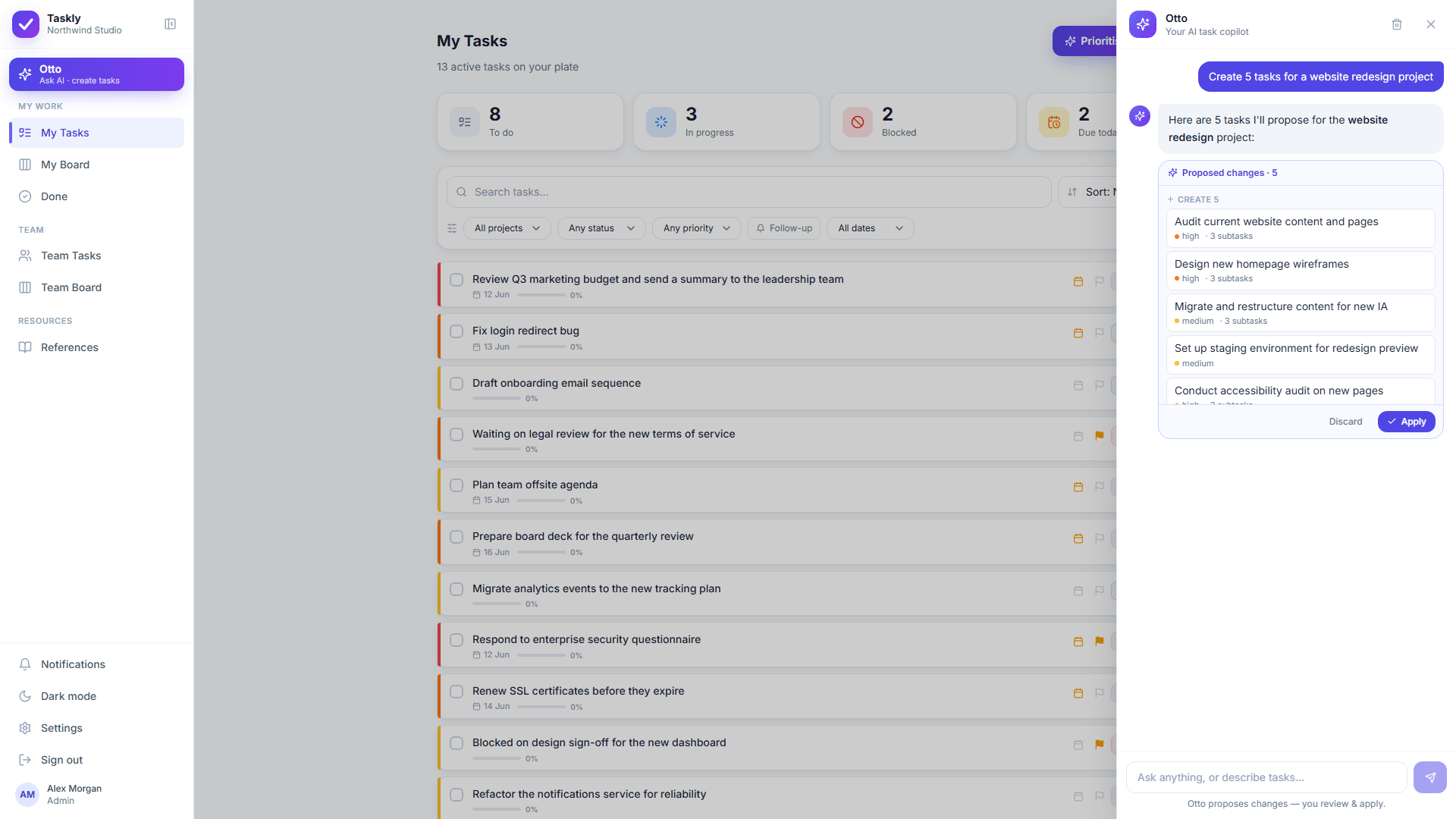
The output of a good standup is a plan: this person, this blocker, by this time. The plan is also the thing that evaporates the moment everybody leaves the call, because writing it up is somebody’s ninth priority. In Taskly you say what came out of the meeting in plain English, and Otto proposes the tasks, owners and due dates as a before and after you approve or discard. Nothing is created until you say so.
app.ottotaskly.com
Otto proposes. Nothing is created, moved or reassigned until you approve it.
This is a meeting template published by a task manager, so it is worth being plain about what the task manager is not.
Taskly has no standup feature
There is no standup bot, no scheduled prompt, no check-in form and no meeting timer in Taskly. The template on this page is text you paste into a calendar invite or a chat channel. Taskly holds the work the standup is about, and nothing more than that.
Taskly does not post into Slack or Teams
The written variant lives in whatever chat tool the team already uses. Taskly has a very small integration surface today and does not push updates into Slack, Teams or Discord, so nobody should plan the written standup around Taskly delivering it.
Taskly is not a Scrum tool
Taskly has boards, subtasks, owners, priorities and recurring tasks. Taskly has no sprints as objects, no story points, no velocity and no burndown chart. A team that needs those should read this template and keep the tool it has.
Otto does not attend the meeting
Otto can turn the plan that came out of a standup into tasks with owners and dates, as a diff you approve. Otto cannot listen to the meeting, cannot take the minutes, and cannot unblock anything. Naming an owner and a time is a human act and stays one.
FAQ
Common questions
What is a daily standup template?+
A daily standup template is a fixed agenda for a short daily team meeting, setting out who speaks, about what, in what order, and for how long. A daily standup template that works has four parts: the goal read aloud, a round that surfaces blockers and decisions rather than status, one named commitment per person for the day, and a parking lot for everything that does not fit the timebox. The free template on this page has all four and can be pasted into a calendar invite or a chat channel.
How long should a daily standup be?+
A daily standup should be 15 minutes. The 2020 Scrum Guide defines the Daily Scrum as a 15 minute event for the Developers of the Scrum Team, held at the same time and place every working day of the Sprint to reduce complexity. The research on stand-ups supports keeping to it: a perceived duration that was too long was one of the three factors that reduced participants’ satisfaction with the meeting. The practical rule is to stop at 15 minutes even if the round is unfinished, and move the remainder to the parking lot.
What are the three questions in a daily standup, and should you still use them?+
The three questions are what did I do yesterday, what will I do today, and what is blocking me. They are the format most daily standup templates still use, and they are no longer in the Scrum Guide: the 2020 revision sets the 15 minute timebox and then states that the Developers can select whatever structure and techniques they want, as long as the Daily Scrum focuses on progress toward the Sprint Goal and produces an actionable plan for the next day of work. The case for replacing them is that "what did I do yesterday" is status reporting, and status reporting aimed at managers was one of the things the research found makes stand-ups worse.
Who should attend a daily standup?+
A daily standup is for the people doing the work. The 2020 Scrum Guide is specific: the Daily Scrum is an event for the Developers of the Scrum Team, and if the Product Owner or Scrum Master are actively working on Sprint Backlog items they participate as Developers. Anyone else is an observer at best. The practical version of this rule is that a manager who attends to collect updates changes what the meeting is, because the round stops being a conversation between teammates and becomes a report.
What should you do with a blocker raised in a daily standup?+
A blocker raised in a daily standup should leave the meeting with a named owner and a time, and should not be solved inside the meeting. Solving it in the room is what turns a 15 minute standup into a 40 minute one while most of the team watches two people talk. Write the blocker in a parking lot with who is handling it and by when, then hold that conversation immediately afterwards with only the people it involves. A blocker still open after three days is usually a decision nobody wants to make, and needs escalating rather than repeating.
Can a daily standup be written instead of live?+
A daily standup can be written instead of live, and for teams spread across time zones it usually should be. The written version keeps the same four prompts, posted in one channel by an agreed time: blocked on, need a decision, today, and changed. What it needs in order to work is a facilitator who reads the posts within the hour and replies under each blocker with a name and a time. Without that the written standup becomes a wall of updates nobody reads, which is a status report with extra steps.
Why do people dislike daily standups?+
People dislike daily standups for reasons that have been studied rather than guessed. Across 102 observed stand-ups and 60 interviews with members of 15 teams in five countries, the researchers found the practice is usually hard to run in a way that benefits the whole team, and that many members have a negative experience of it which reduces job satisfaction, trust in co-workers and wellbeing. The earlier study from the same programme identified the three specific factors that lowered satisfaction: status reporting to managers, meeting too often, and a perceived duration that was too long. All three are fixable by the format rather than by attitude.
Is a daily standup the same as a Daily Scrum?+
A daily standup and a Daily Scrum overlap but are not the same thing. The Daily Scrum is a defined event in Scrum with a stated purpose, a 15 minute timebox and a defined set of participants, the Developers of the Scrum Team. "Daily standup" is the looser industry name for any short daily coordination meeting, including on teams that do not run Scrum at all and have no Sprint Goal to inspect progress against. The template on this page works for both, and the parts that come from the Scrum Guide are marked as such.
Can an AI run your daily standup?+
An AI cannot run your daily standup, and the useful question is which part of the surrounding work an AI can take. What comes out of a standup is a plan: this person, this blocker, by this time. In Taskly you can describe that plan in plain English and Otto proposes the tasks, owners and due dates as a before and after diff you approve or discard, so the plan is captured in under a minute instead of being forgotten by 11am. What no AI can do is notice that somebody is quietly stuck, or decide that a three day old blocker needs escalating.
Is the daily standup template free?+
The daily standup template on this page is free, with no email required and no download. All three blocks, the live format, the written variant and the parking lot log, are on the page as copyable text so they can be pasted into a calendar invite, a chat channel or a document. Taskly itself is also free for the entire product, Otto included, while Taskly is in early access.
The meeting ends. The plan should not.
Describe what came out of the standup and approve the tasks Otto drafts. Free while Taskly is in early access.