
There’s a quiet assumption running through most AI product roadmaps right now: that the goal is to do more for you, with less input from you. Fewer clicks. Fewer confirmations. Fewer moments where the software stops and asks. The dream being sold is a tool you can hand your work to and forget about.
For a lot of tasks, that’s the right dream. Sorting a photo library, drafting a first pass at an email, transcribing a call: if the AI gets it slightly wrong, you shrug and fix it. But for the work you’re actually accountable for, the work with your team’s name on it, we think the “just do it for me” default is quietly wrong. The right default is an AI that asks first.
The default is quietly changing
Watch where the category is going and you’ll notice the check-in disappearing. AI that used to suggest now acts. AI that used to show its work now hides it behind a friendly “Done!” The pitch is always convenience, and convenience is real. But every removed confirmation is also a removed decision, and decisions about your work are exactly the thing you shouldn’t be quietly opted out of.
The failure mode isn’t dramatic. It’s an AI that reassigns a task to the wrong person, nudges a due date it shouldn’t have touched, or “tidies up” by closing something that wasn’t done. No single mistake is a catastrophe. But you didn’t see it happen, so you can’t trust that it didn’t. And once you can’t trust the automation, you end up checking everything it did, which is slower than if it had never helped at all.
Why “just do it for me” is the wrong default here
The question that should decide how much autonomy to give an AI is simple: how much would you regret a wrong move? For low-stakes, easily-reversed work, crank the autonomy up. For shared, accountable work (the kind that lives in a task manager), the cost of a silent mistake is high and the cost of a one-click confirmation is almost nothing. The math isn’t close.
The international standard for AI terminology has a word for a system built this way, and it isn’t a compliment or an insult, just a description. ISO/IEC 22989:2022 defines a heteronomous system as one:
“operating under the constraint of external intervention, control or oversight.”
Product marketing treats “autonomous” as the aspiration and oversight as the training wheels. For work with your team’s name on it, that has the polarity backwards. Heteronomy is the specification, not the limitation.
This is why “ask first” isn’t a lesser, more cautious version of AI. It’s the version that actually fits the job. You still get the leverage: the AI does the drafting, the structuring, the tedious reshuffling. You just keep the one thing worth keeping: the final say.
The diff you approve
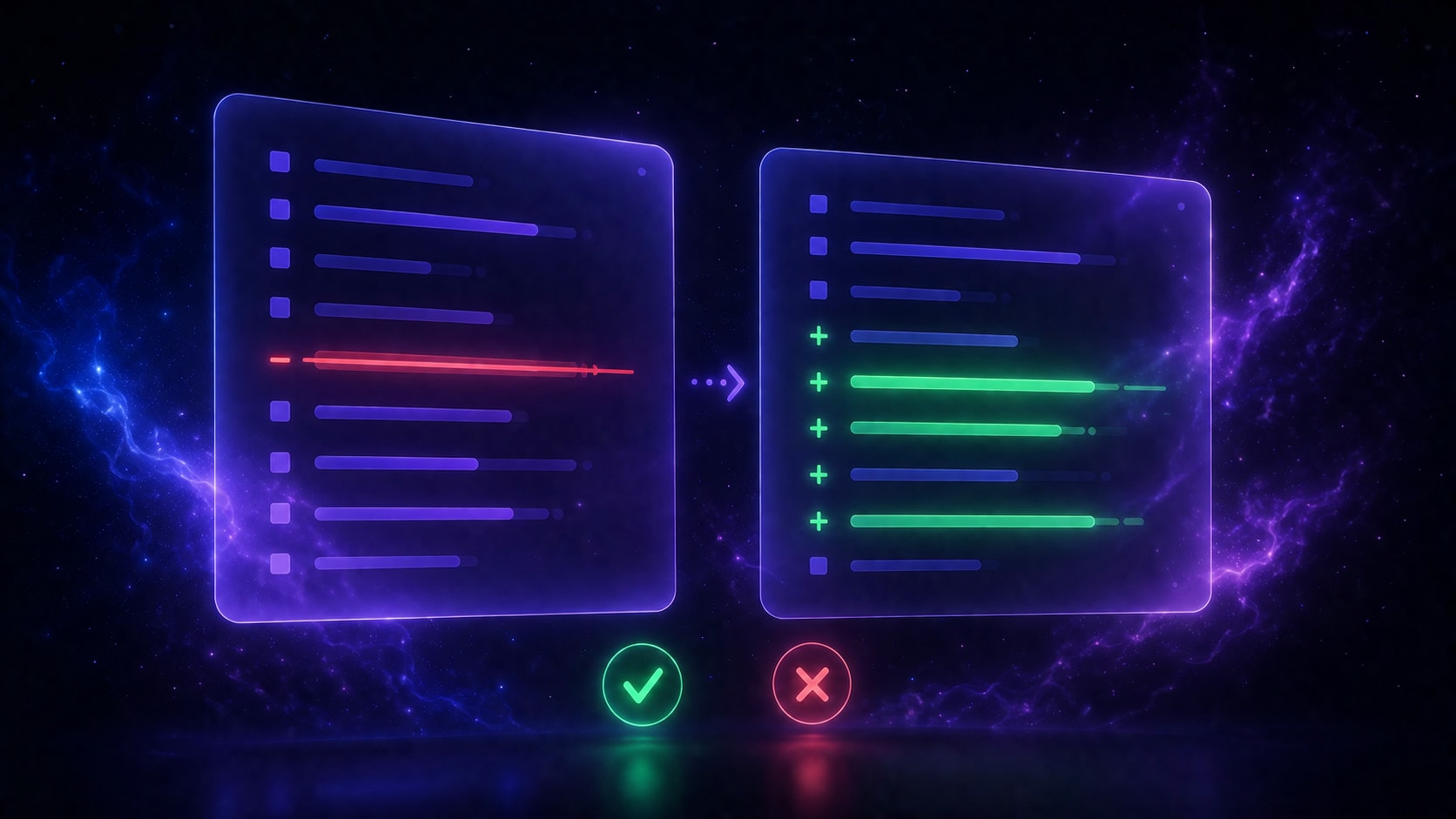
Here’s the model we build around at Taskly. When you ask Otto, our AI assistant, to do something: “break this project into tasks and assign the design work to the team,” it doesn’t just go and do it. It shows you a diff: the exact tasks it will create, the fields it will change, the assignments it will make. Green for what’s added, a clear line through what’s removed. One button applies it. One button throws it away.
It’s the same pattern good engineers have trusted for decades in code review: propose a change, review it, merge it deliberately. Nothing enters the system that a human didn’t wave through. The result is that you can let the AI be genuinely ambitious: draft ten tasks, restructure a whole board, because you know a wrong idea costs you a glance and a click, not a cleanup.
Consent isn’t friction: it’s how trust compounds
The objection to “ask first” is that confirmations are friction, and friction is the enemy. But that treats every click as equal, and they’re not. A confirmation on a trivial action is annoying. A confirmation on a consequential one is respect: the software treating your work as yours to decide.
And there’s a compounding effect. Each time the AI proposes something reasonable and you approve it, you trust it a little more. You start reading the diffs faster, approving more confidently, handing it bigger jobs. Trust earned through visible, consensual actions grows. Trust assumed through silent ones is one bad surprise from collapsing, and after it collapses, you supervise the tool forever.
A quick test for any AI tool
Next time you evaluate an AI assistant (ours or anyone’s), ask it to do something that matters and watch what happens in the half-second after. Does it show you what it’s about to do and wait? Or does it just report that it already did it? That half-second tells you whether the tool was built to be your collaborator or your replacement.
Frequently asked questions
Should AI ask before changing your work?+
What is human-in-the-loop AI?+
Are AI confirmation steps just friction?+
How can you tell whether an AI tool acts without asking?+
What is an AI diff in a task manager?+
Is an AI that asks first less capable?+
We made our choice. Otto is fast, it’s capable, and it will happily do the tedious 80% of organizing your team’s work. It just won’t do it behind your back. If that’s the kind of AI you want managing your tasks, meet Otto, or, if you’re new here, start with what an AI task manager actually is.