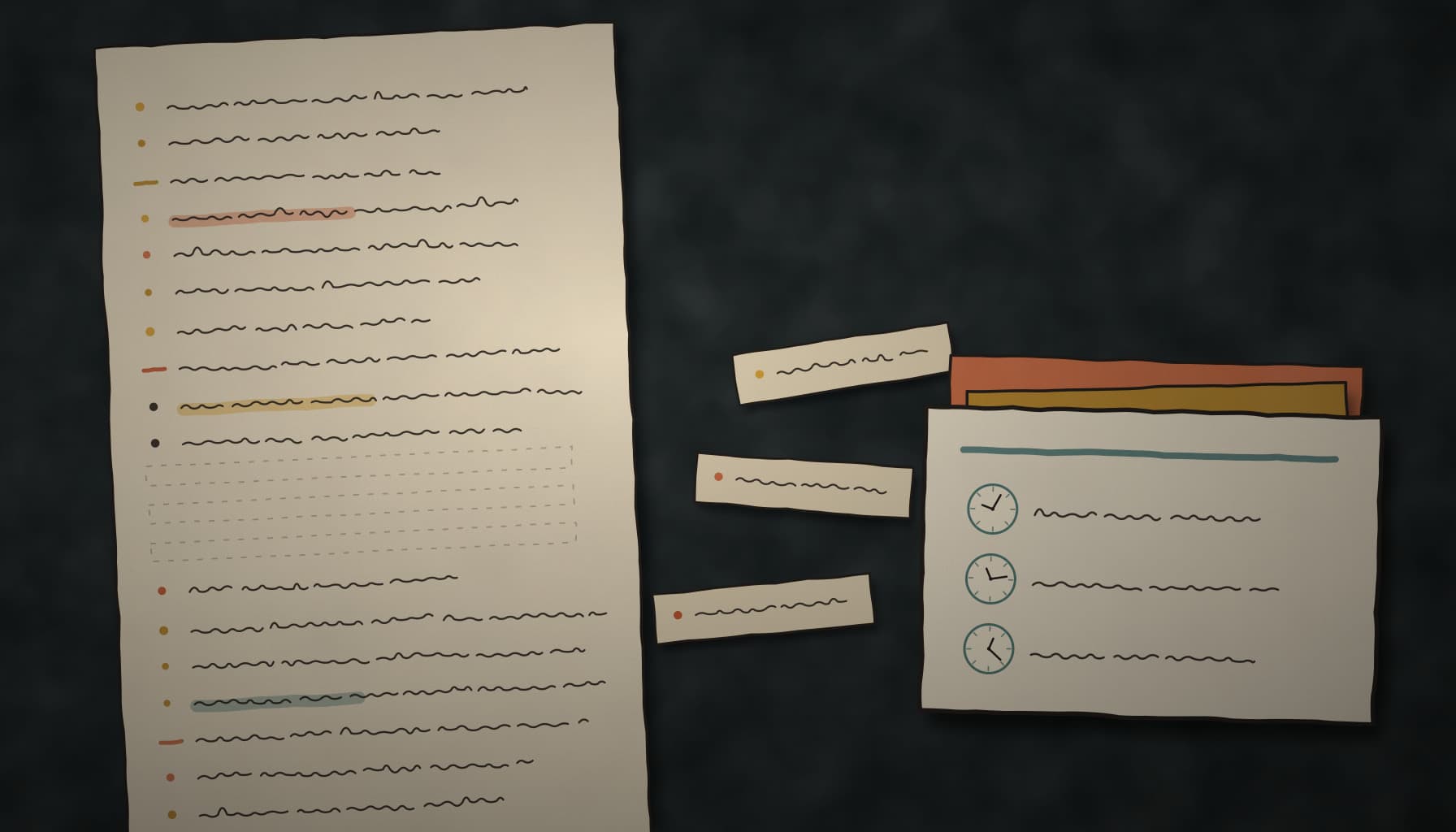

Deep work strategies are the specific moves that protect a block of undistracted, cognitively demanding work and get you back into it cleanly afterwards. Eight hold up in a job where other people book your calendar: put the block in the calendar before the week fills, close the loop on the last task before you switch, place the block in your own peak hours, treat self-interruption as the main threat rather than notifications, leave a written entry point for next time, schedule the recovery break as deliberately as the work, give shallow work its own container, and shrink the block until it survives a bad week.
Notice what is missing from that list. There is no morning routine, no cabin in the woods, and no four hour session. Those are the images the genre is known for, and they are the first things to break in a job with a shared calendar. What is left is a set of transitions, which turns out to be where the research actually points.
“deep work, which I define to be the act of focusing without distraction on a cognitively demanding task”
That definition, from Newport’s own site ahead of the 2016 book, is deliberately narrow. It says nothing about duration, location, or time of day. A deep work strategy is therefore anything that raises the odds of that state occurring and lowers the cost of returning to it, which is a much wider and much more practical brief than “find four uninterrupted hours”.
Why most deep work advice fails in a real job
Most deep work advice fails in a real job because it assumes you control your calendar. In a normal role you control a quarter of it, sometimes less, and the advice quietly reframes a structural problem as a character problem. The measurable failure is not that people cannot concentrate for long stretches. It is that the stretches are short and the entry cost of each one is high.
Gloria Mark, Chancellor’s Professor of Informatics at UC Irvine, has been measuring this since 2004. In 2004 her observations put the average time a knowledge worker spent on one screen before switching at about two and a half minutes. By the time of her 2023 book that average was 47 seconds, with a median over the preceding five years of 40 seconds, meaning half of all observations were shorter than that. She also reports that returning attention to a project after an interruption can take up to 25 minutes.
Put those two numbers beside each other and the arithmetic is the whole problem. If the typical unit of attention is under a minute and the typical recovery is measured in tens of minutes, then a strategy that shortens recovery is worth more than one that extends endurance. That is the logic behind the order of the eight strategies below.
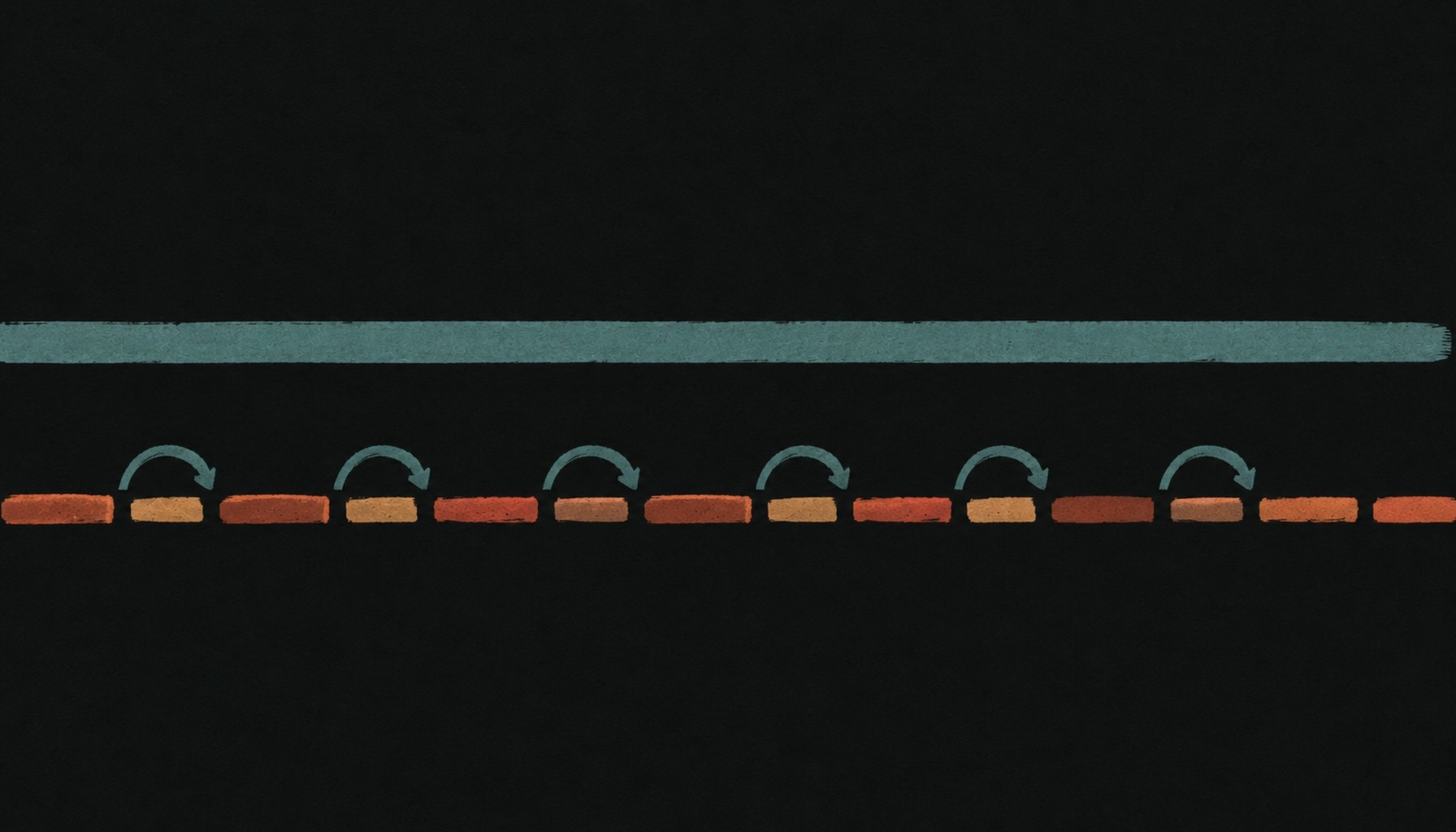
1. Book the deep work block before the week fills
Booking the block first is the only deep work strategy that operates on the actual scarce resource, which is calendar space rather than motivation. A recurring block placed on Friday for the following week competes with nothing. The same block sought on Tuesday morning competes with every meeting already sitting there, and loses, because a request from a person always outranks an intention from yourself.
Two details decide whether this survives. Give the block a specific name, because “focus block” reads as available to anyone glancing at your calendar and “Q4 pricing model, first draft” does not. And treat a cancellation as a move, not a deletion: when something takes the block, put it somewhere else in the same week before you accept. A block that can be deleted without a replacement is a preference, not a commitment.
What the block is for is a separate decision, and the one most people make by instinct. If you want it argued from measured data instead, our Pareto principle examples post covers how to find the small share of work that produces most of your results.
2. Close the loop on the last task before you switch
Closing the loop before you switch is the strategy with the cleanest experimental support, and it is the one almost no listicle includes. Sophie Leroy named the mechanism attention residue in 2009: the part of your attention that stays behind on the previous task after you have formally moved on.
“people need to stop thinking about one task in order to fully transition their attention and perform well on another. Yet, results indicate it is difficult for people to transition their attention away from an unfinished task and their subsequent task performance suffers.”
Two things follow from that finding, and the second is the useful one. First, a deep work block that starts immediately after a meeting starts at partial power, and no amount of willpower inside the block recovers what the transition cost. Second, Leroy found that finishing the previous task was not on its own sufficient: what enabled people to disengage was time pressure while finishing it. A soft ending leaves the loop open even when the work is done.
In practice that means giving the thing before your block a hard stop and a landing. Two minutes at the end of the meeting to write what you owe and by when will do more for the block than fifteen extra minutes of the block itself. This is the same move as the ADHD re-entry routine in the ADHD work planner guide, applied to a transition rather than to a week.
3. Put the block in your own peak hours, not the famous ones
Putting the block in your own peak hours matters more than any technique used inside it, because attention is not evenly available across a day. Mark’s research finds that people have identifiable times of peak focus, most commonly mid to late morning and mid to late afternoon, shifted earlier or later depending on whether you are naturally an early or a late type. Cognitive resources drain, and they drain on a schedule.
The practical version costs one week. Rate your focus out of five at the top of each hour, Monday to Friday. Almost everyone finds two bands and one reliable trough, and the trough is usually where their most demanding work currently sits, because it was the only slot free. Move the block into a band and leave the trough for the shallow work in strategy seven.
The famous 5am block is a special case of this rule, not the rule. It works for people whose peak is early and who therefore gain a band. For a late type it converts a band into a trough and calls the result discipline.
4. Treat self-interruption as the main threat, not notifications
Self-interruption deserves the attention that most deep work advice gives to notifications, because it is the larger half of the problem. Mark reports that people self interrupt around 49% of the time. Turning off notifications, which is where most guides stop, addresses the other half and leaves the bigger one untouched. It is still worth doing. It is just not the strategy.
Self-interruption has a shape: a thought arrives that has nothing to do with the current task, and going to deal with it feels like diligence. The fix is a capture line. Keep one open note beside the work, write the thought in three words, and carry on. What that does is store the thought without opening the app the thought points at, which is where the 25 minute recovery actually begins. The rules for running that inbox afterwards are in the ADHD to-do list guide, and they hold for anyone, not just for ADHD readers.
Mark also reports that people check email an average of 77 times a day, and that batching it into two or three sends did not reliably lower stress or raise self reported productivity in her research. The lever that did more was restricting the window in which messages could be sent at all, which is an organisational decision rather than a personal one. Worth knowing before you spend a month on a personal email protocol.
5. Leave a written entry point at the end of every block
Leaving a written entry point is the cheapest deep work strategy on this list and the one that compounds fastest. Before you close anything at the end of a block, write the exact next action in one line: not “continue the pricing model” but “add the enterprise tier column and check it against the 2025 numbers”. Thirty seconds, at the moment when you are the only person who knows what you were about to do.
The reason this works is the same attention residue finding read backwards. A block that ends mid thought leaves residue you carry into whatever comes next. A block that ends with a written next action converts that residue into a note, which is a closing act, and it means tomorrow’s block starts with a decision already made rather than with ten minutes of reorientation.
If you only adopt one strategy from this page, adopt this one. Every other strategy here assumes you come back, and this is the one that makes coming back cheap.
6. Schedule the recovery, not just the work
Scheduling recovery is a deep work strategy rather than a break from one, because sustained attention is a depleting resource and the depletion is measurable. Microsoft’s Human Factors Lab ran a small study in March 2021 in which 14 information workers wore EEG equipment through four half hour meetings. In one condition the four ran back to back. In the other they were separated by ten minute breaks. Beta wave activity, associated with stress, rose steadily across the back to back stretch and stayed broadly flat for the group that took breaks. The following week the groups swapped.
Fourteen people is a small sample and Microsoft has a product interest in the answer, so treat the finding as directional rather than settled. It agrees with the more general point Mark makes, which is that the ambition to be maximally focused for as long as possible is a myth: nobody expects to lift weights all day. Ten minutes between blocks, ideally away from a screen, is the operational version.
The break has to be scheduled or it becomes the next meeting. On a calendar, an unbooked ten minutes is indistinguishable from availability.
7. Give shallow work its own container
Giving shallow work its own container protects the deep block from the inside. Shallow work is the logistical and administrative work that keeps a job running: replies, approvals, status updates, expenses. It does not disappear because you have booked a block, and if it has nowhere to live it lives inside the block, one small task at a time.
Put a named admin block in the trough hour you found in strategy three. Everything shallow goes there. The point is not that admin is beneath you, it is that admin and deep work want opposite conditions: admin rewards rapid switching, deep work is destroyed by it, and the two cannot share an hour. Anything that turns out to be a real piece of work rather than an errand goes on the list for a future deep block instead.
8. Shrink the block until it survives a bad week
Shrinking the block is the strategy that decides whether the other seven ever run. The instinct after reading about deep work is to schedule three hours. The three hour block gets cancelled twice, the system is declared unworkable, and nothing replaces it. A 45 minute block that happens four times a week is 180 minutes of real deep work. A three hour block that happens once a fortnight is 90.
Set the length at whatever you can complete during your worst normal week, not your best one. Run it for two weeks. Lengthen it only after it has survived a week with a crisis in it. This is the same test as the fourteen day trial in the ADHD apps roundup: a system is working if it still runs on a bad day, not if it looks complete on a good one.

All eight deep work strategies, compared
The eight deep work strategies below are ordered by how much they return for what they cost. Every figure in this table was checked against the primary source on 7 September 2026, and each source is linked where it first appears above.
| Strategy | What it fixes | What it costs | Where it breaks |
|---|---|---|---|
| Written entry point | The reorientation cost at the start of the next block | About 30 seconds per block | You write an intention instead of an action |
| Book the block first | Calendar space, the actual scarce resource | Five minutes on Friday | The block has a generic name and reads as free |
| Close the loop before switching | Attention residue from the previous task (Leroy, 2009) | Two minutes at the end of the meeting | The previous thing has no hard stop |
| Use your own peak hours | Working against your attention curve, not with it | One week of hourly self rating | Peak hours are also when everyone books meetings |
| Design for self-interruption | The 49% of interruptions you generate yourself | One open capture note | The note becomes a second inbox nobody reviews |
| Schedule the recovery | Stress accumulating across consecutive blocks | Ten minutes, booked | An unbooked gap gets read as availability |
| Contain the shallow work | Admin leaking into the block one item at a time | One named admin block per day | Genuinely urgent work gets deferred to it |
| Shrink until it survives | A system that only works in a perfect week | Ambition | You never lengthen it once it is stable |
A week you can copy
This week shape assumes a normal job: meetings you did not schedule, a peak band in the mid to late morning, and a trough after lunch. Adjust the bands to the ones your own week of hourly ratings found, then run it unchanged for two weeks before you tune anything.
FRIDAY, 10 MINUTES
  Book next week's blocks first, before anything else lands.
  Name each one with the actual work, not "focus".
  Four blocks. If four cannot fit, book three and stop.

EACH DEEP BLOCK (60 to 90 minutes)
  Before   Hard stop on the previous thing. Two minutes:
           write what you owe and by when. Loop closed.
  Start    Capture note open beside the work. Phone in a drawer.
  During   Stray thought goes in the capture note in three words.
           Nothing gets opened. Nothing gets answered.
  Last 30s Write the exact next action, in one line.
  After    Ten booked minutes away from a screen.

TROUGH HOUR, DAILY
  One admin block. Replies, approvals, expenses, the capture note.
  Anything in there that is real work goes to a deep block instead.

FRIDAY AGAIN
  Count the blocks that actually happened.
  Four out of four for two weeks running: lengthen by 15 minutes.
  Two or fewer: shorten by 15 minutes. Do not add willpower.
If you want the whole week laid out rather than just the deep blocks, the time blocking template puts this shape into a copyable grid, with the buffers, the admin block and the Friday review already in place.
What the evidence does not say
The evidence behind deep work strategies is thinner than the confidence of most articles about them, and it is worth being precise about which parts are load bearing.
- Attention residue is well established; the size of its cost in your job is not. Leroy’s 2009 finding comes from two controlled experiments, and it tells you the effect is real and directional. It does not license a percentage figure about your own output, and you should be suspicious of any page that supplies one.
- The 47 second attention span is an average across observations, not a limit. Mark is explicit that people sometimes stay focused far longer, and that the median in the five years before her 2023 book was 40 seconds. The number describes how fragmented screen attention has become, not how long you are capable of concentrating.
- The break study is small. Fourteen participants, one company, one fortnight, and the company sells meeting software. It is a reasonable reason to try ten minute gaps. It is not proof that they work for you.
- Deep work is not flow, and chasing flow is the wrong target. Mark argues that flow is unrealistic for most knowledge work, because that work is analytical rather than performative, and that focus, which requires effort, is the achievable state. If your measure of a successful block is losing track of time, most successful blocks will read as failures.
- None of this is a treatment for anything. If concentration has changed sharply, or the difficulty is with starting rather than with staying, that is a different problem from a badly shaped week, and the planning tools guide is a better starting point than this page.
Where Taskly fits
Taskly is a task manager, not a focus app, and it does not run your calendar. It is relevant to exactly two of the eight strategies above, and it is worth saying which, because a tool that claims to solve all eight is claiming to solve your calendar.
- The written entry point has somewhere to go. The one line next action goes on the task itself, so the next block opens with the decision already made rather than with a reconstruction.
- The capture note stops becoming a second inbox. Paste the block’s stray thoughts in and ask Otto to split them into separate items, break the ones that are really projects into steps, and propose dates. Reviewing a proposal costs less than sorting a pile, which is why the pile usually wins otherwise.
- Nothing moves without your approval. Otto shows every proposed change as a before and after you accept or discard, so a triage you ran on Friday cannot quietly rearrange the block you protected for Tuesday.
- Rescheduling a lost block is one move. “Push everything I didn’t finish to Thursday” is one request and one approval rather than twenty edits, which is the difference between moving a block and deleting it.
What Taskly does not do: it is not a calendar, it will not block your notifications, and it cannot defend an hour against a colleague. If the assistant part is the interesting bit, the AI task manager page covers what it does and what to check before trusting any tool with your list.
The short version
Deep work strategies are transition management, not endurance training. Book the block before the week fills, close the loop on whatever came before it, put it in your own peak band, capture stray thoughts instead of chasing them, and write the next action down before you leave. Book the ten minutes after it. Give admin its own hour. Then make the block short enough that a bad week cannot delete it, and lengthen it only once it has proved it can survive one.